Your building's inspection report (IEE): who needs it, what it costs and what happens if it finds problems
Buildings age the way we do: slowly, without warning and almost always where we are not looking. A rust stain on the edge of a balcony, a hairline crack nobody remembers appearing, a stair tile that sounds hollow. Nothing seems urgent until a chunk of concrete falls onto the pavement.
That is why there is the Building Assessment Report (Informe de Evaluación del Edificio), known in the Valencian Community as the IEEV.CV. It is a mandatory technical inspection for residential buildings over 50 years old and, although the law has required it since 2018, most owners' associations still do not have one. In 2021, only 3% of the buildings in the province of Alicante that needed one had submitted it.
Here we explain who needs it, what is inspected, how much it costs and, above all, what happens when the report finds problems.
Who has to have one
It is regulated by Decreto 53/2018 of the Consell (the Valencian regional government). It applies to residential buildings, both blocks of flats (the classic owners' associations) and single-family houses. The following are required to have one:
- Buildings more than 50 years old. The building's age is taken from the Cadastre (Catastro), unless another date can be proven. The deadline to submit it is 31 December of the year after the building turns 50.
- Buildings that want to apply for public grants for refurbishment, whatever their age.
A building built in 1975 turns 50 in 2025 and has until 31 December 2026 to submit its report. One from the sixties, like so many in our towns and along the coast, should already have one.
The report covers the whole building, not each home, so in a block of flats it is commissioned and paid for by the owners' association. Once registered, it is valid for 10 years. After that it has to be renewed.
What is inspected
The IEEV.CV has three parts. All three look at the building as a whole, not inside each home:
| Part | What the expert checks |
|---|---|
| State of repair | Foundations and structure, façades, balconies and overhangs, roofs and roof terraces, and the shared water and drainage installations. |
| Accessibility | The route from the street to the door of each home: steps, ramps, clear widths, lift. It indicates what reasonable adjustments could be made. |
| Energy efficiency | It includes the building's energy performance certificate (EPC), with its rating and recommended improvements. |
Installations that already have their own mandatory inspection, such as the lift or the electrical installation, are excluded, as is everything inside each home.
Each defect is graded by its importance (negligible, low, moderate or high) and by the action it requires: maintenance, medium-term intervention o urgent intervention. The report ends with a statement of the building's state of repair.
Who signs it and how it is processed
It is signed by an expert qualified to draw up projects or manage residential building works: an architect, a building engineer (arquitecto técnico) or an ingeniero de edificación. It is drawn up with the Generalitat's official application and submitted online to the Regional IEEV.CV Register. From then on, the town hall can consult it.
In practice, this is our process:
- We ask for the cadastral reference, the year of construction and, if available, the drawings or the original project.
- We visit the building: façades, roof, entrance, stairwell, plant rooms and, if possible, the basement or crawl space. A morning is usually enough.
- We draw up the report and the energy performance certificate, and we register them.
- We give the owners' association the report with a clear summary of what needs doing and in what order.
From acceptance of the quote, it usually takes about three weeks.
How much it costs
It depends mainly on the size of the building: the number of homes and entrances, whether there are commercial units, how many façades, roofs and courtyards it has, and travel. As a guide, these are the indicative fees that come from the cost study by the Instituto Valenciano de la Edificación (IVE), which calculates the hours of inspection, data collection and drafting according to the type of building:
| Building | IEE.CV only | IEE.CV + energy performance certificate |
|---|---|---|
| Detached house | €525 – €600 | €815 – €940 |
| Up to 9 homes | from about €850 | from about €1,150 |
| 10 to 19 homes | from about €1,150 | from about €1,600 |
| 20 to 39 homes | from about €1,500 | from about €2,100 |
| 40 to 60 homes | from about €2,000 | from about €2,900 |
If the building does not have an energy performance certificate, it makes sense to do both jobs together: the same visit is used and it works out 10 to 15% cheaper than commissioning them separately. Shared among the owners and over ten years, the report usually costs very little per home: in a building of 20 homes, about €75 each. We give a fixed quote after seeing the building and its documentation.
The Generalitat (Valencian regional government) also offers grants to pay for the report. In the 2025 call they covered 80% of the eligible amount, or 100% if the report included the fire protection annex, for reports registered from May 2024. New rules were approved in June 2026. If you are interested, we will look into it with you before starting so you don't miss the call.
What happens if the report finds problems
It is the question people fear most, and the answer is calmer than it seems. A report with defects is not a fine: it is a diagnosis. What the report does is put in writing something that was already there, and rank the repairs by urgency.
- If the damage is a maintenance matter, the owners' association includes it in its normal planning: cleaning downpipes, sealing, small repairs.
- If a medium-term intervention is needed, it is best to commission a repair project or report, get comparable quotes and plan the special levy (derrama) well in advance.
- If something is urgent, such as a balcony edge coming loose, you have to act now: first make it safe (remove loose material, fit a net or fencing) and then repair. The town hall can issue an enforcement order with a deadline.
Works needed for the upkeep and safety of the building (and, in some cases, accessibility works) are compulsory for the owners' association and do not need prior approval from the owners' meeting. The meeting decides how the cost is shared and over what period it is paid (article 10.1 of the Horizontal Property Act, Ley de Propiedad Horizontal).
A real case in Torrevieja
An owners' association of 24 homes in Torrevieja called us after their IEE. The report had found spalling on the edges of the floor slabs, streaking on the façade because the overhangs had no drip groove, corrosion in the railing anchors and a step at the entrance that made wheelchair access impossible. We prepared the repair project, ramp included, and the site supervision. With a well-defined project, the association could get quotes that were genuinely comparable and share out the work knowing exactly what they were paying for.
Why on the coast you need to look at it sooner
Sea air carries salt. Over the years, chlorides work their way through the concrete until they reach the steel reinforcement, and in older buildings carbonation of the concrete cover adds to the problem. The steel rusts and, as it rusts, it expands: it pushes the concrete from inside, cracks it and ends up blowing off slab edges, balcony fronts and overhangs. The Código Estructural (Structural Code) considers structures less than 5 km from the coast to be exposed to this marine environment: Torrevieja, Guardamar, Santa Pola and Orihuela Costa are squarely within it.
That is why, on the coast, rust showing through is not a cosmetic issue. It is the visible symptom of something that has been going on inside for some time, and the sooner it is dealt with, the cheaper the repair.
And what if the owners' association doesn't do it?
Not having the report when it is mandatory is a planning offence. The town hall can require the owners' association to submit it within two months and, if it does not, commission the inspection itself and pass on the cost. What is more, without the IEEV.CV you cannot access public refurbishment grants, which are precisely the ones that help pay for repairs.
But the real reason to do it is not the fine. It is knowing what condition the place you live in is in, and being able to decide calmly rather than in a rush.
In short
- If your building is more than 50 years old, it needs the IEEV.CV, and it is the owners' association that commissions it.
- It checks the state of repair, accessibility and energy efficiency of the common areas, and is valid for 10 years.
- It costs little compared with what it can prevent, and there are grants to help pay for it.
- If it finds defects, it is not a sentence: it is the order in which repairs need to be made.
If you are an owners' association in the Vega Baja, Elche, Alicante or the Vinalopó and want to know whether it applies to you, write to us via the contact page with the building's address. We will tell you what you need and how much it would cost. More information on our service for building inspection report (IEE/ITE).
Further reading
- Decreto 53/2018, of 27 April, of the Consell, regulating the Building Evaluation Report for residential buildings and its Regional Register (DOGV of 7 May 2018).
- Real Decreto Legislativo 7/2015, consolidated text of the Land and Urban Regeneration Act (Ley de Suelo y Rehabilitación Urbana), article 29.
- Law 49/1960, Horizontal Property Act (Ley de Propiedad Horizontal), article 10.1.
- Real Decreto 470/2021, Código Estructural (Structural Code) (exposure classes in marine environments).
- Instituto Valenciano de la Edificación, IEEV.CV methodology and application.
- Instituto Valenciano de la Edificación (IVE), study of the costs of preparing the IEE.CV and the EPC.
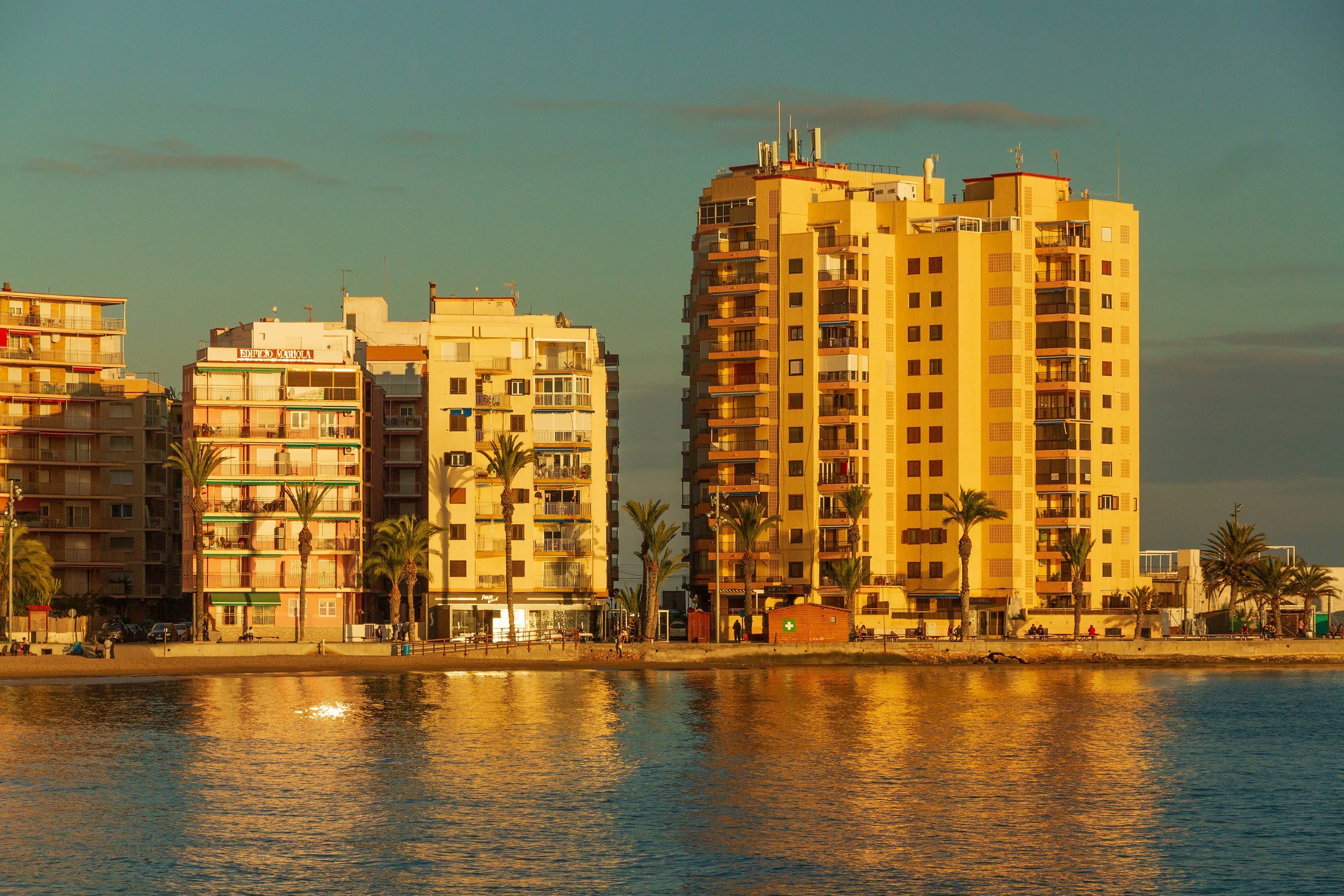
Cover photo: apartment buildings next to Playa del Cura, in Torrevieja. Photo: Ximonic (Simo Räsänen) · CC BY-SA 4.0, via Wikimedia Commons.