Two flats joined in the Land Registry: how to separate them so they can be sold individually
It's more common than you'd think: two neighbouring flats bought years ago by the same family, joined to make a bigger home and registered in the Land Registry as a single property. Years later they want to sell them separately, or split them in an inheritance, and it turns out that legally they are no longer two flats, but one.
Separating them can be done, but a partition wall alone won't fix it. You also have to undo what was done on paper. We walk you through the steps with a real case we handled recently.
Why building works aren't enough
A block of flats is divided into what the law calls horizontal property (propiedad horizontal): each flat is a property with its own number in the Land Registry, its share in the owners' association and its reference in the Cadastre (Catastro). When two flats are joined into one, that division changes. To separate them again it has to be modified once more, and that has three fronts:
- The physical side: bricking up the opening between the homes and making sure each one has its own entrance, kitchen, bathroom and utilities.
- The administrative side: depending on the case, an authorisation from the town hall and, afterwards, the occupancy of each home.
- The legal side: the owners' association agreement, the deed before a notary and registration in the Land Registry.
What the law says
Under the Ley de Propiedad Horizontal (Horizontal Property Act), dividing a flat to create smaller, independent ones requires the approval of the meeting of owners (three fifths of the owners, who must also represent three fifths of the shares) and the administrative authorisation that planning law requires to modify a horizontal property division.
But there is an important exception: that authorisation is not needed when the number and characteristics of the resulting homes match those in the building permit (licencia de obra) of the building. In other words: if the building was built with two flats and they were only joined later, separating them takes you back to what was already authorised. Proving this with drawings and documents is a large part of the architect's work.
It's also worth reading the owners' association statutes: sometimes they already authorise this kind of change and make the agreement simpler.
The case, step by step
Two homes joined into a single property, which the owners wanted to sell separately. This is how we solved it:
- Preliminary report for the notary. First of all, a report explaining the situation and what needed doing, so the notary and the parties knew where they stood.
- Site visit, survey and drawings of the “joined” and “separated” states, with the floor area and share that would correspond to each home.
- Technical certificate of separation, describing the two resulting homes and justifying that they match the building's original ones.
- Owners' association approval, which is then incorporated into the deed.
- Deed modifying the horizontal property division, which in this case was signed together with the sale, and registration in the Land Registry.
- Separation works with their declaración responsable (works notice): bricking up the opening and the kitchens that were needed.
- Second occupancy of each home and separate meter connections.
The last step is often forgotten: each home needs its own occupancy certificate to sign up for water and electricity. We explain it in Second occupancy to connect electricity and water. And if they are going to be sold, each one will also need its own energy performance certificate (EPC).
How much it costs and how long it takes
It depends on the floor area and how complicated the case is, so we quote it after seeing the land registry extract (nota simple), the statutes and the homes. On top of that come the notary, the Land Registry, the separation works with their fee and tax, and the occupancy certificates for each home.
The timing depends mainly on the owners' association and the notary. If the neighbours approve it without any trouble and no town hall authorisation is needed, it can be sorted in a few months.
Before you start, gather this
- The land registry extract (nota simple) for the property, to see how it is registered.
- The horizontal property division deed and statutes of the owners' association.
- If there is one, the building permit (licencia de obras) originally granted for the building, or its project.
- The deed by which the flats were joined, if there was one.
With that we can tell you which route applies, whether town hall authorisation will be needed and how much it would cost. If you're in the Vega Baja, Elche, Alicante or the Vinalopó, write to us via the contact page. More information in horizontal property division (división horizontal).
Further reading
- Ley 49/1960, de Propiedad Horizontal (Horizontal Property Act), articles 5, 10.3 and 17.6.
- Real Decreto Legislativo 7/2015, consolidated text of the Ley de Suelo y Rehabilitación Urbana (Land and Urban Renewal Act), article 26.6.
- Real Decreto 1093/1997, supplementary rules to the Reglamento Hipotecario on the registration of planning-related acts.
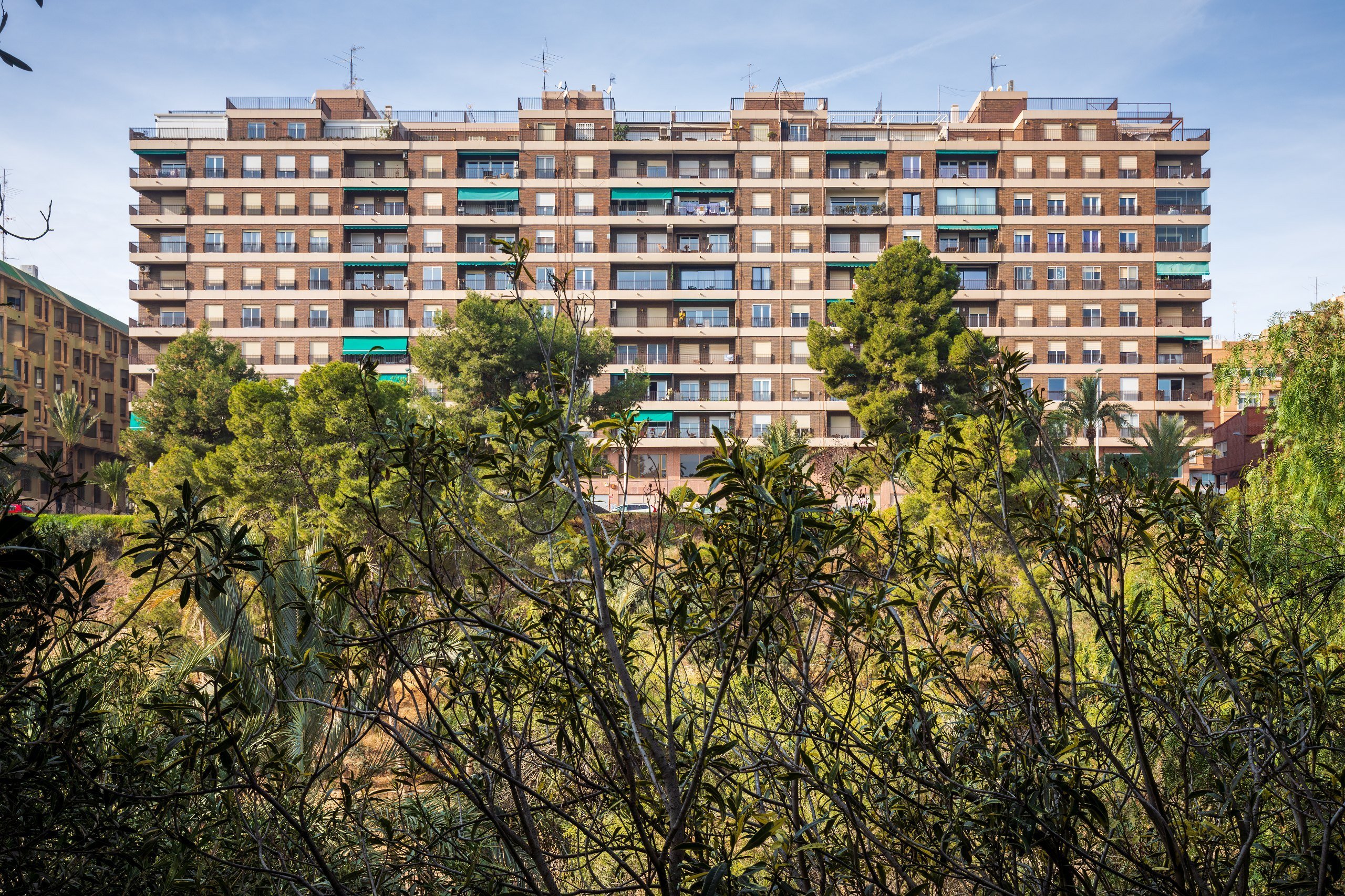
Cover photo: residential building in Elche, seen from the Parque Municipal. Photo: Ximonic (Simo Räsänen) · CC BY-SA 4.0, via Wikimedia Commons.