Expert report, opinion or certificate: what you need and what it costs
Almost every dispute over a house starts the same way: a damp patch that keeps growing, a crack that was not there before, building work that has not turned out as agreed, a wall nobody knows who owns. And almost all of them get stuck at the same point: each side has its own version, and neither is technical.
That is where the architect comes in as an expert witness. Not to side with whoever is paying, but to explain with evidence what has happened, why, and how much it will cost to fix. That work may be called a report, an opinion or a certificate, and asking for one is not the same as asking for another. Here we explain the difference, when you need each one and what they cost.
Report, opinion or certificate
People use them as synonyms, but they are not:
| Document | What it does | When it is requested |
|---|---|---|
| Technical report | It sets out in writing what the expert has observed: the condition of a building, some damage, some measurements, some documents. It explains, but does not rule on who is right. | To find out the condition of something before buying, repairing or negotiating. |
| Expert opinion (dictamen pericial) | As well as describing, it gives a reasoned technical opinion: what caused the damage, whether the work matches the contract or the regulations, and how much the repair will cost. | When there is a dispute: with a neighbour, a builder, an insurer or in court. |
| Technical certificate | It attests to a fact or condition the expert has verified: a floor area, a building's age, that a home meets certain requirements. It gives no opinion and makes no assessment. | For a formal procedure: the notary, the Land Registry, the town hall, a utility company. |
The Civil Procedure Act (Ley de Enjuiciamiento Civil) always speaks of a dictamen(expert opinion), because in court what the expert witness is asked for is precisely their technical opinion. In practice, we usually deliver both together: a report with everything observed and measured, and an opinion that sums up the conclusions.
Party-appointed or court-appointed expert
If the matter ends up in court, there are two ways an expert witness can be involved:
- Party-appointed expert. Chosen and paid for by one of the parties, and their opinion is normally filed with the claim or the defence. If there is not enough time, it is announced and submitted later, within the deadlines set by law.
- Court-appointed expert. The court chooses them by lot from the lists sent to it each year by the professional associations. One of the parties requests it (or both, who may agree on a single expert), and whoever requests it pays the fees in advance.
In both cases, the expert declares under oath or affirmation that they have acted as objectively as possible and that they are aware of the criminal consequences of not doing so. They may be called to court to explain their opinion and answer questions from the parties and the judge, who weighs the expert opinions according to the rules of sound judgement (sana crítica). That is why a good expert opinion is not the one that sounds most emphatic, but the one that best stands up to questioning.
An expert witness is nobody's lawyer. If an opinion only works as long as nobody questions it, it does not work.
What a good expert report should include
There is a standard that sets out the structure of expert reports, UNE 197001:2019. It is not mandatory, but it is a recognised reference in the field, and following it gives everyone peace of mind. Our reports always follow it:
- Identification: who commissions it, who signs it, which property it covers and on what date.
- Statement of impartiality and oath or affirmation.
- Purpose and scope: which questions are answered and which are not. This is the part that prevents the most disputes.
- Background and documentation: title deeds, drawings, quotes, contracts, earlier photos, orthophotos.
- Analysis: the site visit, the measurements, tests where needed, and the technical reasoning.
- Conclusions: clear, numbered and answering exactly what was asked in the purpose.
- Appendices: photographic record, drawings, sketches and calculations.
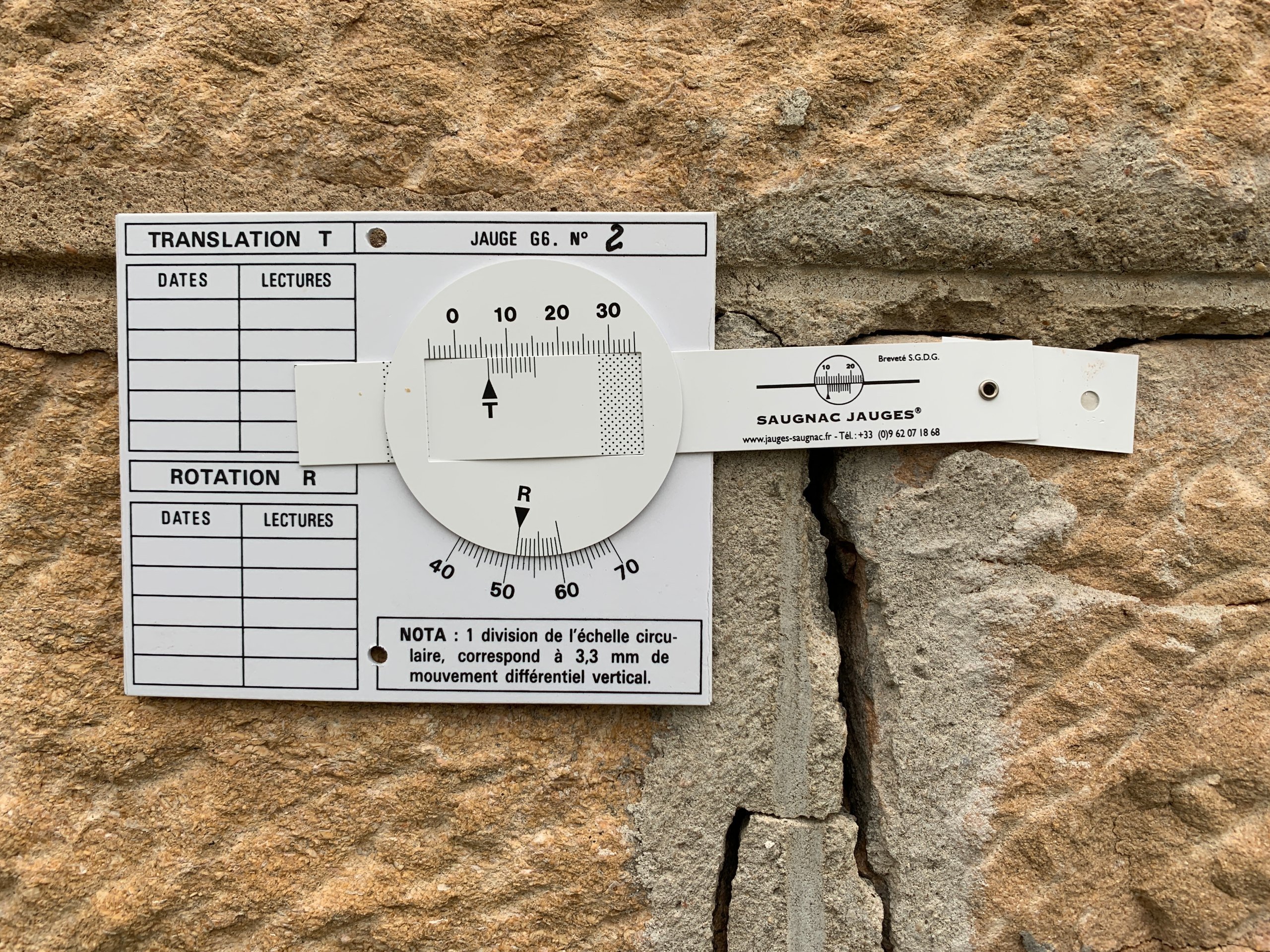
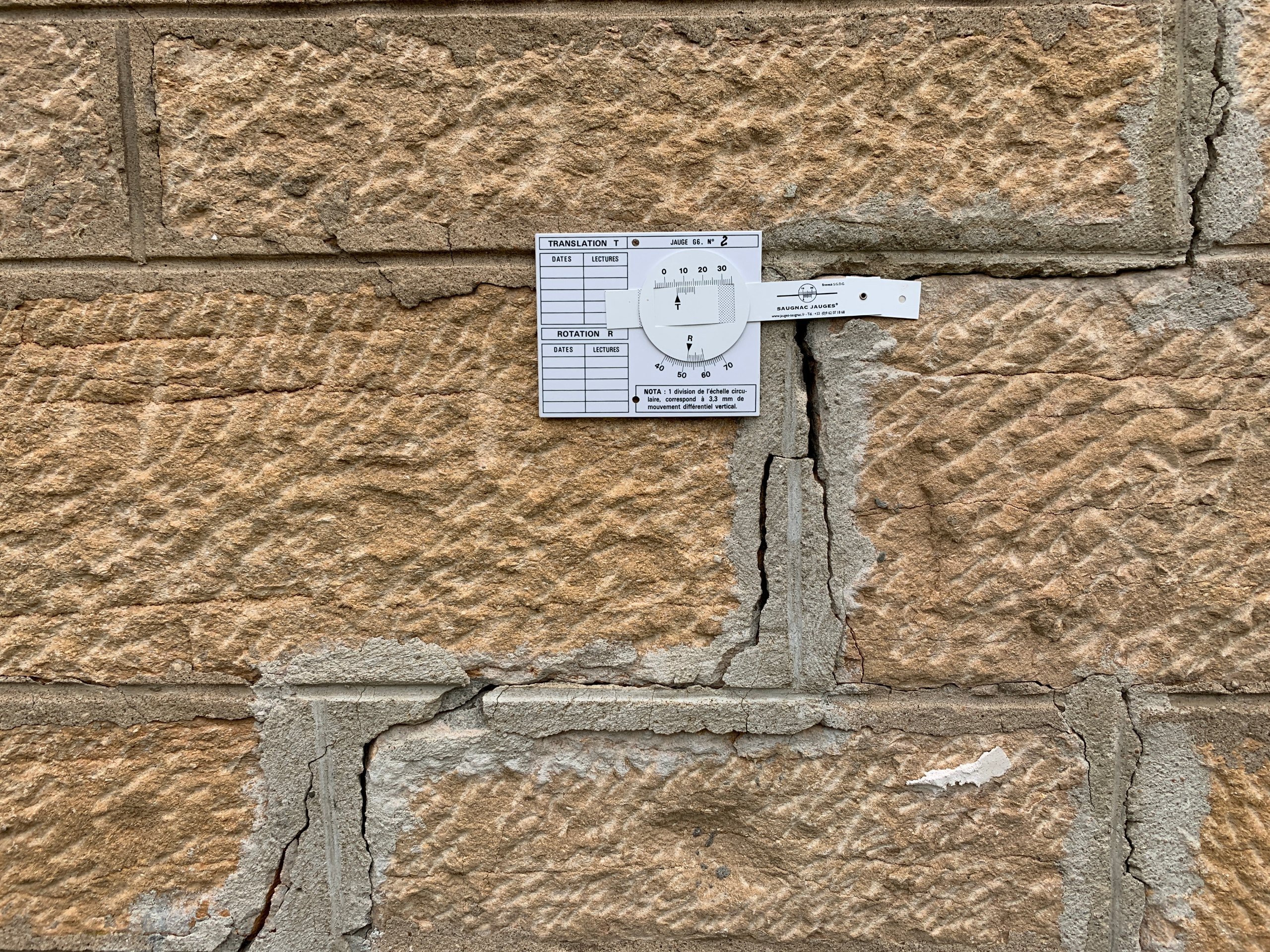
To measure, we use simple but objective tools: a laser distance meter, crack gauges and tell-tales to see whether a crack is still opening, a hygrometer for moisture and, when needed, total station surveys or comparisons of orthophotos from different years.
The cases we see most
- Damp: where it comes from (leaks, rising damp, condensation or a pipe) and who should fix it. Often the neighbour's house is not to blame, and sometimes it is.
- Cracks: whether they come from settlement, thermal movement, a sagging floor slab or nearby works; whether they are stable or still moving.
- Defects in building or renovation work: whether what was built matches the project, the quote and the regulations, and how much it will cost to put right.
- Party walls and boundaries: who owns a wall, where the boundary runs, whether a building work has encroached on the neighbouring property.
- Hidden defects in a property sale: defects that could not be seen at the time of purchase and that make the home less usable or less valuable.
Don't let time slip by
In building disputes, deadlines matter as much as evidence. The most common ones (those under the LOE, the Building Act, for buildings whose permit was applied for from May 2000 onwards):
| Situation | Time limit |
|---|---|
| Damage to a building's structure (LOE, art. 17) | 10 years from handover of the works |
| Defects affecting habitability: damp, insulation, services (LOE, art. 17) | 3 years from handover |
| Finishing defects, the builder's responsibility (LOE, art. 17) | 1 year from handover |
| To claim for that damage once it appears (LOE, art. 18) | 2 years from when it occurs |
| Hidden defects in a property sale (Civil Code, art. 1490) | 6 months from handover |
What is more, since April 2025, before bringing a civil claim you must first try to reach a negotiated solution: direct negotiation, mediation or a binding offer, among other means (Organic Law 1/2025). At that stage, a sound technical report is often what unlocks an agreement: when both parties can see in writing what caused the damage and what it costs to repair, there is often no need to go to court at all.
How much an expert report costs
Architects' fees are deregulated: there are no official rates and the professional associations are not allowed to recommend any. To work out ours, we take into account:
- The time it will take: how many questions need answering, how much documentation needs reviewing, how many visits and journeys.
- The technical complexity of the job, and whether any testing or a specialist collaborator is needed.
- The amount being claimed, because it determines the liability the expert witness takes on.
- The urgency.
It depends a great deal on the case: how many issues need answering, the floor area, the measurements or tests required and the travel involved. A simple report, with one visit and a single question, has nothing to do with a complex one; and if the problem is serious, the work can multiply. We will tell you before we start. If it has to go to court, the ratification (preparing for the hearing and attending court) is quoted separately, by the hour or as a fixed item, plus travel.
If the case goes to trial and the other party is ordered to pay costs, the expert witness's fees form part of those costs (article 241 of the Civil Procedure Act), within the limits set by law.
What we need to get started
- A brief explanation of the problem and what you want to find out or prove.
- The cadastral reference or the IBI (property tax) bill, and the land registry extract (nota simple) of the property.
- Everything you have: photos from when the damage appeared, contracts, quotes, invoices, drawings, emails or formal notices.
- If proceedings are already under way, the deadlines and your lawyer's contact details.
With that, we can tell you whether the case stands up technically, what kind of document you need and how much it would cost. Sometimes the honest answer is that an expert opinion is not worth it, and we will tell you that too. Drafting usually takes 10 to 15 working days from when we have the documentation.
In short
- A report describes, a dictamen gives a reasoned opinion and a certificate attests to a fact.
- You choose the party-appointed expert; the court-appointed one is chosen by the court by lot. Both swear to be objective.
- A good expert opinion follows UNE 197001 and answers exactly what it is asked.
- Watch the deadlines: some are only six months.
- The report often helps reach an agreement before trial.
If you have a problem with a home or a building in the Vega Baja, Elche, Alicante or the Vinalopó, write to us via the contact page. More information on our service for expert reports.
Further reading
- Law 1/2000, Civil Procedure Act (Ley de Enjuiciamiento Civil), articles 335 to 352 (expert opinions) and 241 (costs).
- Law 38/1999, Building Act (Ley de Ordenación de la Edificación), articles 17 and 18.
- Civil Code, articles 1484 to 1490 (warranty against hidden defects).
- Organic Law 1/2025, on measures for the efficiency of the Public Justice Service (appropriate dispute resolution methods).
- Standard UNE 197001:2019, General criteria for the preparation of expert reports.
Cover photo: a tell-tale monitoring a crack in the façade of a church. Photo: Chabe01 · CC BY-SA 4.0, via Wikimedia Commons.