Housing in Spain: the problem isn't the bricks, it's the process
An analysis with data and without party slogans: why it is so hard to access housing in Spain and what can really be done about it. Written from an architecture studio that works between Alicante and Murcia.
Before we start: where we are writing from
We are an architecture studio that works on site between Alicante and Murcia: housing projects, permits, legalisations, expert reports and property valuations. We see the housing problem from inside the process (the application that drags on, the budget that doesn't add up, the building nobody refurbishes), and that is what we want to contribute: data and craft, not slogans.
The rule for this text is simple. Every figure comes with its source, cited at the end of each section, and when something comes from our own experience on site, we say so. When a figure is our own estimate, we say so. And when the data can be read two ways, as sometimes it can, we present both. You won't find “it's all the investment funds' fault” here, nor “the market will sort itself out”. What you will find is what the Banco de España, the INE (National Statistics Institute), the Ministry of Housing, the Colegio de Registradores (Association of Land Registrars) and academic research say, organised into twelve sections, with charts, a set of short- and long-term measures and, at the end, a theoretical exercise: what would happen if all this were applied in a medium-sized town like the ones in our area.
It's a long article. The problem deserves it.
The diagnosis in figures: there aren't enough homes, by a long way
Spain is short of around 750,000 homes. The figure comes from the Banco de España, in its 2025 Annual Report (presented in June 2026), and it is calculated simply: it is the cumulative difference since 2021 between the homes completed and the households formed. It amounts to roughly 4% of households. For comparison: Italy is at around 1.5% and France is practically in balance; in relative terms, Portugal and the Netherlands are worse off than we are. The problem isn't only a Spanish one, but here it is a big one.
The gap can be explained with two numbers. In 2025, Spain completed around 92,000 homes, while the number of households grew by around 240.000 (the 2021–2025 average is about 245,000, according to the INE). Homes granted planning endorsement (visados) for new build, which anticipate what will be completed in one or two years, came to 139.016, 8.8% more than in 2024: the best figure since 2008. And the shortfall isn't evenly spread: more than half (52.5%) is concentrated in six provinces, Madrid, Barcelona, Alicante, Valencia, Murcia and Málaga, home to 36% of households. Our province is on that list.
Reading the chart. Two things stand out. First: even with the recovery, the homes given visados in 2025 cover just over half (≈ 58%) of the roughly 240,000 households formed that year, and completed homes barely more than a third (≈ 38%). The annual gap is still open and the shortfall is still growing. Second: the 2006 peak in visados shows that this country knew how to produce housing on a large scale, with excesses best not repeated. What happened after 2008 wasn't that we forgot how to build: much of the capacity to do so was destroyed (financing, companies and workforce). That is the thread running through the rest of the article.
Sources: Banco de España, presentation of the 2025 Annual Report (18-6-2026) · 2025 Annual Report, BdE repository · Ministry of Housing, Annual Bulletin of the Housing and Land Observatory 2024 (visados 2005–2024) · INE, Continuous Population Statistics · 2025 visados (Ministry figure, via Alimarket)
Who is the landlord in Spain? What the data say
Who owns rented housing? Tax data allow us to answer quite precisely. According to the Banco de España, more than 90% of primary homes let at market rent belong to private individuals, and around 8% to companies of every kind, from SOCIMIs (property investment trusts) and funds to family holding companies (2021 tax data). With that 2021 data, the Banco de España estimated that individuals with more than ten homes accounted for no more than 7% of market rentals (an upper bound). With more precise 2024 data, those letting eleven or more homes are 0.2% of landlords and hold 2.4% of the homes let by private individuals.
The share held by companies varies greatly by region: from 2.6% in Extremadura to 10.3% in Madrid and 11.1% in Catalonia. In some neighbourhoods of the big cities their influence is real; across the country as a whole, it is small.
Reading the chart. Half of the homes let by private individuals belong to someone who lets only one. Landlords with eleven or more homes hold 2.4%. The typical landlord in Spain is an individual with a spare flat, not a big corporation.
The nuance. The fact that large owners don't explain the problem as a whole doesn't mean there are no cases that explain the mistrust. In 2013, Madrid's municipal housing company (EMVS) sold 1,860 rented social homes to a SOCIMI owned by an international fund, and the Community of Madrid, through IVIMA, sold another 2,935 to another investment company. The IVIMA sale was annulled by the courts; the EMVS sale stood after a long legal battle. Episodes like these exist and weigh on the debate, but across the market as a whole their weight is small.
Sources: Banco de España, Occasional Paper 2432 on the rental market (2024), pp. 30-31 and table 1 · BdE, 2023 Annual Report, ch. 4, p. 240 · BdE, presentation of the 2025 Annual Report (slides 38-39) · Madrid City Council: sale of the EMVS homes (2018) · Legal Advisory Committee of the Community of Madrid, opinion 292/24 (IVIMA sale)
The Catalan experiment: what happens when rents are capped
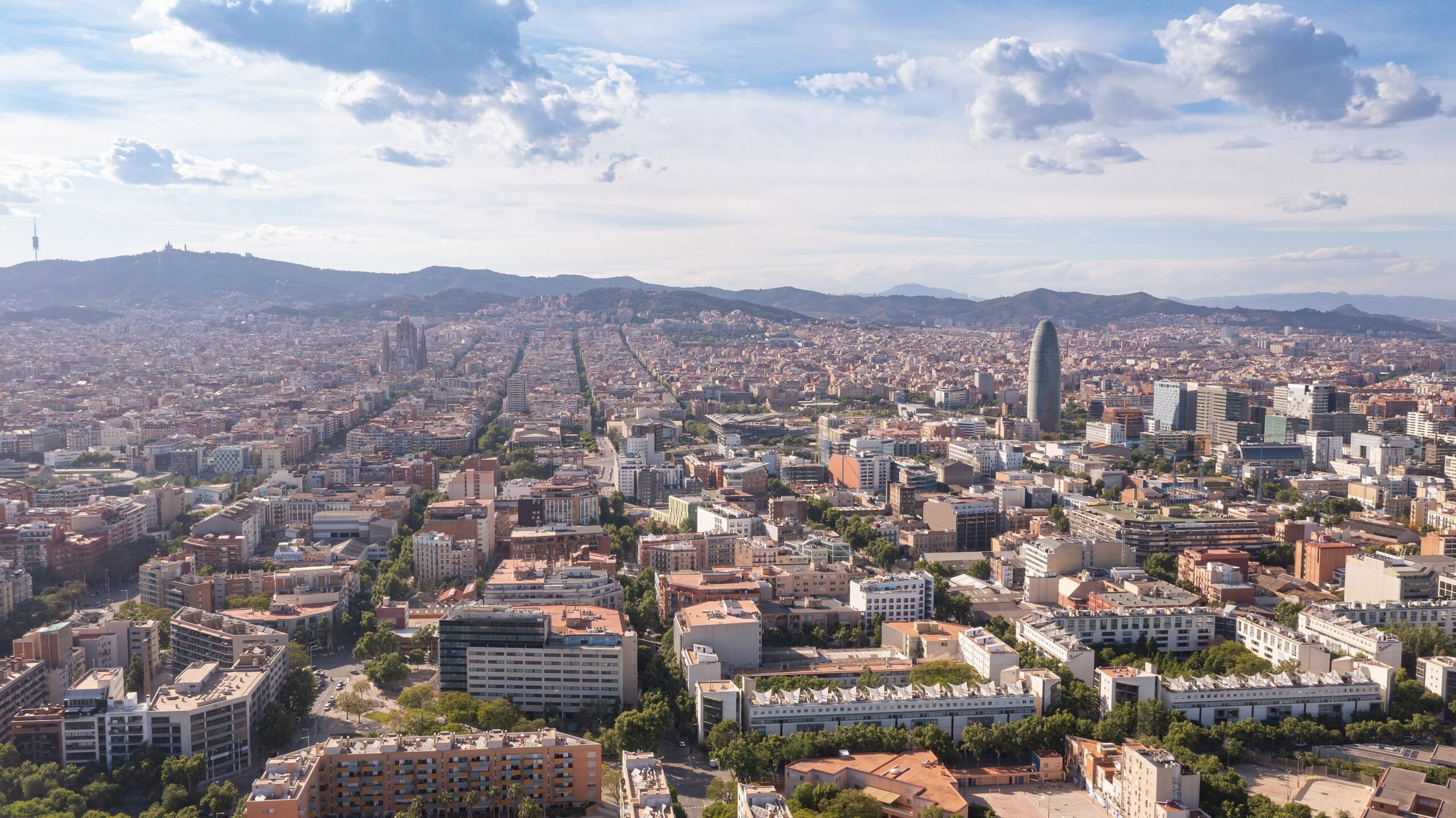
Since 16 March 2024, 140 Catalan municipalities have been declared a stressed residential market area under the national Housing Law 12/2023. Since October 2024 there have been 271, home to around 90% of Catalonia's population. In them, a new contract cannot exceed the rent of the previous one from the last five years, and if the landlord is a large holder or the home has not been let in that period, it cannot exceed the national reference index either. In July 2026 the Generalitat proposed extending the declaration with a map of 302 municipalities, pending approval. It is the biggest rent-control experiment in Spain in decades, and there is already data to judge it by. It is worth looking at both readings, because both are backed by data.
Reading A: what prices show. According to INCASÒL deposit data released by the Generalitat, between Q1 2024 and Q3 2025 rents on new contracts rose a cumulative 0.8% in the stressed areas and fell 3.3% in the city of Barcelona, compared with +5.7% in municipalities without a cap. The latest available figure (Q1 2026) shows a year-on-year rebound (+3.7% in the stressed areas and +4.6% in Barcelona), but the cumulative change since the cap came in is still negative (−1.3% and −4.7%), while outside the stressed areas rents are up 9.5%. Within the regulated contract, the cap works: whoever signs within the limit pays less.
Reading B: what supply shows. A study published by Fedea in June 2026 (F. Pinto, using data from the Barómetro del Alquiler) concludes that, between Q1 2024 and Q4 2025, advertised long-term rental supply fell by 22.2% in the province of Barcelona and 20.5% in Catalonia, while in Madrid it grew by 3.9%. The same study confirms that advertised prices were moderated (+5.7% in Catalonia against +8.5% in Madrid); note that this is not comparable with reading A, which measures rents on signed contracts. And the escape valve was seasonal (short-term) letting, which was not capped: according to idealista, in the city of Barcelona long-term listings fell by 56% and seasonal ones rose by 58% between March 2024 and the end of 2025. Across Spain, seasonal lets already make up 29% of rental listings (idealista, Q2 2026).
Catalonia responded with Law 11/2025, of 29 December, in force since 1 January 2026: seasonal and room lets are now subject to the same rent limits, the reason for the temporary let must be documented and, if it isn't, the home is presumed to be a permanent residence. In Q2 2026 seasonal supply in Barcelona fell 42% year on year. Part of the law has been challenged before the Constitutional Court.
Reading the chart. In less than two years, the make-up of advertised supply in Barcelona was turned on its head, and the new law has partly turned it back. The homes didn't disappear: largely, they changed regime. Those who managed to sign a long-term contract paid less; those looking found less on offer.
What international research says. The result comes as no surprise to anyone who knows the literature. In San Francisco, Diamond, McQuade and Qian (American Economic Review, 2019) studied the 1994 extension of rent control: affected landlords cut their rental supply by 15%, which pushed up rents across the city by 5.1%, although protected tenants gained stability (their likelihood of staying in their home rose by between 10% and 20%). In Berlin, with the Mietendeckel of 2020, listings for regulated flats fell from over 600 to around 300 a week (DIW, 2021); the German Constitutional Court struck the law down in March 2021 because the Land lacked the competence, not because of its content.
In short, the available evidence suggests that rent control protects those already inside and shrinks the market for those looking. It isn't a slogan from either side; it is the trade-off each society decides whether to accept, and for how long.
Sources: BOE: resolution of 14-3-2024 (140 municipalities) · Ley de Arrendamientos Urbanos (Urban Leases Act), art. 17 · Generalitat: prices in stressed areas (22-2-2026) · 3Cat: Q1 2026 data (14-7-2026) · Fedea, Apuntes 2026/15 (F. Pinto) · idealista: two years of stressed areas · idealista: supply Q2 2026 · Catalan Law 11/2025 (BOE-A-2026-5547) · Diamond, McQuade and Qian (2019), AER 109(9): 3365-3394 (NBER w24181) · DIW Wochenbericht 8/2021 (Berlin)
Land: it's not space we're short of, it's process
Spain doesn't have a territory problem: it has a problem of ready-to-build land, land that has already been through the whole planning process and lets you apply for a building permit tomorrow. The Banco de España itself points out in its 2025 Annual Report that the shortage of buildable land, slow delivery and limitations in planning management hold back the capacity to build new homes. In its 2023 report it had already shown that prices have risen most where there is least ready-to-build land.
Those of us who work in this live it application by application (what follows is the studio's experience, not statistics). Developing a sector of land, from the moment the plan zones it until it can be built on, means going through detailed planning, programming, land readjustment (reparcelación) and urbanisation works: in practice, 10 to 20 years. A building permit can take months or years depending on the town hall. Many municipalities work with local plans that are thirty or forty years old, with old town centres limited to ground floor plus two or three storeys and bylaws designed for another era.
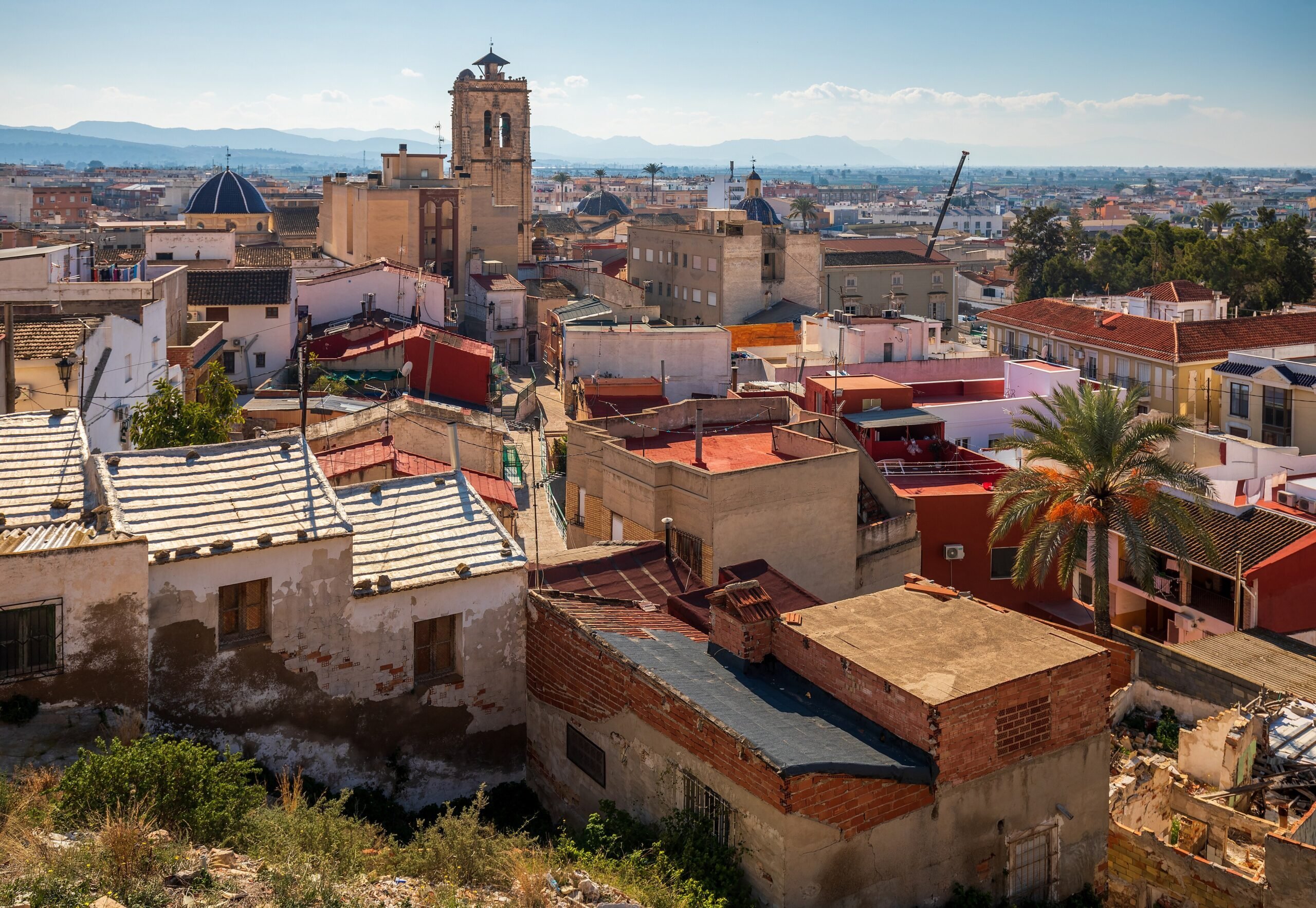
And one figure that debunks a cliché: Spain is already a country of flats. According to Eurostat, 65% of the population lives in a flat, the highest share in the European Union, ahead of Latvia (64%), against an average of 48%. The problem isn't that “we don't like density”: it's that the planning rules that govern it are never updated.
On top of that, renewing what is already built (the other great source of land, the vertical one) runs up against four locks:
- The last neighbour. Putting together three or four plots with different owners gives each of them a veto, and the last one always asks for more. Compulsory land readjustment exists on paper, but in our experience it is almost never used for this (in section 5 we propose another way out).
- The Ley de Propiedad Horizontal (Horizontal Property Act). Demolishing and rebuilding a block of flats by decision of the owners requires, in practice, unanimity (articles 17.6 and 23). This is only avoided if the building is considered destroyed (rebuilding it costs more than 50% of its value), if it is declared in a state of ruin, or if the authorities include it in an urban renewal area. A single owner can block the whole building.
- Timescales. An internal reform plan can take 5 to 10 years of actual processing (the studio's experience). Little private capital is willing to be tied up for that long with that risk.
- Economic viability. In much of inland Spain, the sale price doesn't cover the cost of building (we quantify this in section 6).
The legal tools exist: internal reform plans, transfers of development rights (which, incidentally, were pioneered in the Normas Subsidiarias of Petrer, Elda and Ibi between 1978 and 1985, before Law 8/1990 made them general), the rehabilitation agent, the register of vacant plots, declarations of ruin. What is missing is a process that makes them work within reasonable timescales. Land in Spain isn't a scarce resource: it's a slow one.
Sources: BdE, 2025 Annual Report · BdE, 2023 Annual Report, ch. 4 · Eurostat, Housing in Europe 2025 · Ley de Propiedad Horizontal (BOE) · P. Mosto Zavala, doctoral thesis (UPC, 2019) on transfers of development rights · Processing times: the studio's professional experience
Renew or patch up: combining plots, building upwards, freeing up land
This is where a proposal we stand by as professionals comes in. In the centres of our towns and cities there are thousands of buildings far from today's standards: no insulation, no accessibility, structures at the end of their life. When those buildings come down, through ruin or demolition, the plot is usually rebuilt just as it was: narrow, low and 100% built over. The sensible alternative is different: combine three or four adjoining plots and build a single building with a smaller footprint and more height. The same buildable floor area or more, with a smaller footprint: land is freed up to widen the street, park or create public space, and the town can breathe.
This diagram has one virtue: you get it straight away. But behind it there are two questions that decide whether it works or stays on paper. The first: how do you win over the last neighbour? The second: when should a building be replaced and when should it be properly refurbished? We answer them in order.
The key: your old house for a new flat
The hardest lock to open is the last owner who won't sell (we saw it in section 4). Our proposal is that they don't have to sell, but rather swap. A public body (the town hall or the regional housing agency) acts as both coordinator and guarantor: the owners of the three houses contribute their plot and, in exchange, each receives a new flat in the resulting building, at no cost, with rehousing covered while the works last. The extra storeys allowed by the buildability bonus are what pay for the construction.
It isn't a new invention: it's the good old swap of plot for finished flats (permuta de solar por obra), the arrangement that built half of Spain. The difference is the public guarantee, which is exactly what the elderly neighbour who doesn't trust a developer is missing. For them, the change means going from an uninsulated 1960s house, with stairs and damp, to an accessible flat with a lift that meets the Building Code (CTE), on the same street and without paying a euro. When that's the offer, the veto stops making sense.
Using the costs from section 6, the numbers for a typical scheme look like this (our own estimate):
| Item | Approximate figure |
|---|---|
| Ground floor plus four storeys on three plots | ≈ 975 m² built, 12 homes |
| Construction cost, excluding land (≈ €1,330/m²) | ≈ €1.30 million |
| Homes for the three owners (3 × 80 m²) | 240 m² |
| Floor area left to sell or let | ≈ 735 m² |
| Price that covers costs, with no profit | ≈ €1,765/m² |
| Price that covers costs with a 15% margin | ≈ €2,075/m² |
| Shortfall per scheme inland (selling at ≈ €1,650/m²) | ≈ €85,000 – €315,000 |
On the coast and in provincial capitals, where new builds already sell above those prices, the scheme pays for itself. Inland there is a gap, and that is where the other half of the idea comes in: covering it with the public money that currently goes on patch-ups (we'll come to that shortly). That's between €7,000 and €26,000 per new home, plus rehousing the three families during the works, in exchange for a new building designed to last many decades, instead of stretching out for another fifty years one that has nothing more to give. And the mandatory transfer of part of the increased buildability can become a public rental home within the building itself.
The arithmetic is on our side. The land cost per buildable m² (repercusión de suelo) (what the land costs for every square metre that can be built) falls as buildability rises. A round example: a €300,000 plot with 1,000 m² of buildable floor area works out at €300/m²; if the plan allows 2,000 m², with the same plot price, it works out at €150/m². Half. Two caveats: in practice, the landowner will try to capture part of that extra buildability, and the law generally requires between 5% and 15% of the increase to be handed over to the authorities. Even so, that margin may be exactly what many renewal schemes are currently missing to stack up.
It isn't theory: Japan has been doing it since 1970. Its “comprehensive design system” allows large plots to exceed buildability and height limits in exchange for open space for public use, and Tokyo's regulations explicitly justify it as a way to combine plots. In Japan, the average home that is demolished is about 32 years old (67 in the United States, 81 in England): the housing stock is renewed constantly. Tokyo, with around 14 million inhabitants, started 122,130 homes in 2025, almost as many as the whole of England and on the order of the visados for the whole of Spain: about three times as many per inhabitant. For a quarter of a century Japanese rents barely moved, although since 2023 Tokyo's have been rising sharply. It isn't about copying skyscrapers: it's about copying the mechanism, height and intensity in exchange for public space.

Refurbish properly or replace: what costs dear is the halfway house
Arguing for replacing worn-out buildings doesn't mean refurbishment is bad. Quite the opposite: what's bad is the cosmetic makeover, the facelift that changes tiles and floors and leaves the building the same inside. Each patch-up of that kind on a worn-out building (the 1960s shop turned into a 70 m² ground-floor home, the superficial renovation of an inherited flat) buys it, in our view, another 40 or 50 years of life and blocks the renewal of the whole block. It's the lock-in effect.
Refurbishing properly is something else, and some have shown it better than anyone. The French architects Anne Lacaton and Jean-Philippe Vassal, winners of the 2021 Pritzker Prize, argue for the opposite of demolition: transformation. Between 2011 and 2017, together with Frédéric Druot and Christophe Hutin, they transformed three 1960s social housing blocks in the Grand Parc in Bordeaux, 530 homes, without moving anyone out: residents stayed in their homes during the works. It wasn't a cosmetic renovation. They kept the structure and added to each home a winter garden and a balcony almost four metres deep, with a new façade, more light and lower energy use. The transformation cost around €27 million, roughly €51,000 per home, and, as was noted when they were awarded the Pritzker, around a third of what demolishing and rebuilding would have cost.
The lesson isn't “always refurbish” or “always replace”. It's that both, done properly, work, and what doesn't work is the bit in between: the renovation that doesn't reach current regulations, doesn't insulate, doesn't improve accessibility, doesn't renew the services and, for that very reason, solves nothing. This is how to tell them apart:
| Cosmetic makeover | Proper refurbishment | |
|---|---|---|
| Façade and roof | Repainted | Continuous insulation, new windows, no thermal bridges (CTE DB-HE) |
| Accessibility | Same as before | Lift and accessible route wherever feasible (DB-SUA) |
| Building services | Covered up | New electrics, water, drainage and ventilation (REBT, DB-HS) |
| Structure | Not checked | Assessment and strengthening if needed (DB-SE) |
| Habitability | Same as ever | Today's standards of light, ventilation and room sizes; more space if possible |
| Who is accountable | Nobody | Project, supervising professional and construction guarantees |
| Result | The problem, postponed | A building for another fifty years |
That leads to a second proposal, a very professional one: a compulsory “refurbish or replace” test before public money is given to a building. Three questions, answered by a professional standing in front of the building:
And here is today's paradox. Of the €6,820 million in Recovery Plan grants for housing and regeneration, around €5,800 million fund the refurbishment and regeneration of existing buildings and €1,000 million new social rental housing on public land; on top of that come €4,000 million in ICO loans for affordable rental. The refurbishment programmes require energy improvements, but they don't ask whether the building deserves to stay standing, and replacing an obsolete building has no place in them (other schemes have allowed for it, with much smaller budgets). The result is that public money can end up extending the life of buildings that, looking fifty years ahead, should perhaps make way for others. With the test, that same money would go to properly refurbishing what deserves it and to covering the swap shortfall where replacement is the right call.
And one point that matters to us as architects: making the process and uses more flexible doesn't mean lowering quality. A new home has to meet every requirement of the Building Code (CTE), and so does a refurbished one: there are no second-class homes. Converting commercial premises into a home, done properly, with habitability, light and ventilation, is one of the quickest ways to create housing. What we don't support is ground-floor homes without enough light or ventilation, however much a regulation or bylaw may allow them: that produces substandard housing today and obsolete stock tomorrow. The formula: flexibility in the what, where and when; none in the how.
Sources: National Land Law (TRLSRU), art. 18.2.a · Japanese Ministry of Land (MLIT): comprehensive design system, 1970 · Tokyo Metropolitan Government guidelines · MLIT: age of demolished housing · Tokyo: housing starts in 2025 · GOV.UK: new housing in England · Japan rent index (OECD, via FRED) · At Home: advertised rents in Tokyo (August 2026) · Recovery Plan, Addendum, component 2 · Royal Decree 853/2021 (refurbishment programmes) · Lacaton & Vassal: transformation of 530 homes, Grand Parc (Bordeaux) · CNN: 2021 Pritzker Prize and cost compared with demolition · Metropolis: Lacaton & Vassal's strategy · Land cost per buildable m², swap, test and diagrams: our own work
Why nobody builds in inland Spain: replacement cost
There is a technical concept that explains much of what happens inland and almost never comes up in the debate: replacement cost, meaning what it costs today to produce one square metre of new housing, everything included. When the market price is below that cost, nobody develops: neither the big developer nor the small local investor. It is not speculation or ill will; the numbers simply do not add up.
This is an indicative breakdown for a modest block of flats in an inland town, with rounded 2026 figures. It is our own estimate: it starts from the building cost module of the Instituto Valenciano de la Edificación (IVE) (€950/m² since June 2026) and from our experience with developments in the area.
| Item | €/m² built (approx.) |
|---|---|
| Construction cost (PEM) | ≈ 950 |
| Builder's overheads and profit (19%) | ≈ 180 |
| Professional fees, studies and insurance | ≈ 70 |
| Construction tax (ICIO) and municipal fees | ≈ 40 |
| Development, financing and sales costs | ≈ 90 |
| Land cost per m² (town centre, low value) | 150 – 250 |
| Total cost, excluding VAT | ≈ 1,480 – 1,580 |
| Developer's margin (15 – 18% of sales) | ≈ 260 – 350 |
| Required sale price, excluding taxes | ≈ 1,750 – 1,930 |
A note on tax, because it is easy to get wrong: the VAT on the works is not a cost for the developer, who recovers it. It is paid by the buyer of a new home (10% VAT plus 1.4% stamp duty (AJD) in the Valencian Community), just as the buyer of a resale home pays transfer tax (ITP, 9% as a general rule since June 2026). That is why we compare prices excluding taxes. Including them, someone buying a new build would pay around €1,950 – 2,150/m². Self-build is a different matter: an individual building their own home cannot recover the VAT, so there the 10% really is a cost.
Now for the other side of the scales. In many inland towns of the Vega Baja, resale homes are advertised at between €870 and €1,250/m². The market pays between half and two thirds of what it costs to build new. We compare with resale housing because it is the local buyer's real alternative: in these towns there is hardly any new build to compare with, and that in itself is a symptom. The result: in those towns professional development is marginal, almost everything is renovation and self-build, and development concentrates on the coast and in the cities, where buyers do pay above replacement cost.
Reading the chart. The shaded band is the viability frontier. To its right (coast and city) development works; to its left, it barely exists. One figure that qualifies the sums: in Almoradí a new development is advertised at €1,500 – 1,650/m² (asking price), below our estimate; that only works with very cheap land or very tight margins, and it tells us the frontier is moving. That is why “building more” means different things depending on where: in the stressed markets of the city and the coast, more new build; inland, renovating the existing housing stock, which is exactly what sections 4 and 5 propose. And that closes the circle: renovation runs into the four padlocks y with these numbers. It only works if the extra buildable area makes the land cheap enough or if prices rise, which is what is already happening in the entry-level segment (with year-on-year rises of between 5% and 38% in these towns).
Sources: IVE, basic building cost module · idealista, sale prices by municipality (province of Alicante) · Ley del IVA (VAT Act), art. 91 · Valencian Community: ITP and AJD rates 2026 (Garrigues) · Cost breakdown: Unité Arquitectura's own estimate
Even if there were land: not enough hands or firms to build it
Suppose all the land were released tomorrow and every permit were fast-tracked. We would still hit a physical wall: the sector's production capacity was destroyed in 2008 and has not fully recovered. According to the Labour Force Survey (EPA), construction went from around 2.7 million workers in 2007 to fewer than one million in 2013–2014, and today it stands at around 1.6 million (1.56 million at the end of 2025 and slightly more in 2026): still around 40% below the peak. At the end of 2025, 63% of firms in the sector said that the labour shortage was limiting their activity, according to the Banco de España.
There is a second, less talked-about problem: the business fabric is highly fragmented. Firms with more than 250 workers account for barely 10% to 15% of employment in the sector, according to the Banco de España, and construction productivity has been stagnant for decades. Why is there not more investment in machinery, processes and structure? In our view, because 2008 taught a hard lesson: in a sector where one cycle can wipe you out, building up capital is risky. Anyone who has asked for a quote knows the result: crews with few resources, self-employed tradespeople unable to bid for a whole building, timescales that keep stretching.
The consequence is structural: well-organised contractors go where there is volume and a clear margin (large developments, public works), while the individual who wants to build a house, or the small local developer, depends on whatever crew is available. That makes exactly the kind of small and renovation work that inland Spain needs more expensive, slower and worse.
There are three known ways out, and none is quick: industrialised construction (manufacturing in a factory and assembling on site, which reduces dependence on on-site labour and which the Banco de España recommends promoting), dual vocational training that makes the trades attractive, and labour migration that is orderly and skilled. We add a proposal of our own: aggregated public procurement, with public authorities commissioning industrialised housing at scale, can give manufacturers the steady volume that the private market alone does not guarantee.
Sources: INE, EPA Q4 2007 · INE, EPA Q4 2013 · INE, EPA Q1 2026 (includes Q4 2025) · INE, EPA Q2 2026 · BdE, presentation of the 2025 Annual Report (labour shortage, firm size and recommendations)
Social housing: why Spain built a lot of it and has very little today
The figure that sums it up: in Spain, one in every 65 primary homes is social housing (1.5%), compared with an OECD average of 7% (around 8% in the European Union) and one in three households in the Netherlands, where it is mostly run by non-profit organisations. And it is not because none was built: for decades, Spain built a great deal of protected housing (vivienda protegida). The mistake was one of design: it was mostly built for ownership and with only temporary protection. Once that period ended, those homes went onto the open market and a public housing stock never took shape.
On top of the design problem, the current mechanism has two flaws:
- The mandatory reserve. Since May 2023, national law requires at least 40% of residential buildable area in new developments, and 20% in urban renewal or regeneration, to be reserved for protected housing, and, as a general rule, half of that reserve to be for rent. The aim is to expand the protected supply, and its effect depends on the design. Urban economics has studied this (it is known as inclusionary zoning): it works as a charge on development, which can be passed on to open-market housing, to a lower land price (if the reserve is known before the land is bought) or to lower viability. US studies find moderate effects (prices around 2% higher and, in some markets, slightly lower output) and better results when the requirement is offset with more buildable area: “I ask you for 40%, but I let you build more”. In Spain this is rarely done systematically.
- Maximum prices below cost. In the Valencian Community, maximum prices for protected housing went untouched for more than ten years while construction costs soared from 2020 onwards. In many cases, the numbers for private protected developments did not add up. They were updated in 2023 (€2,200/m² of usable floor area), in December 2024 (€2,400/m²) and again in 2026, to around €2,568/m² of usable floor area. Inland, the real limit is not that maximum price but what local buyers can afford.
What design does work. There is more technical consensus here than it might seem, and the Banco de España recommends it too: a permanent public rental stock, developed through public-private partnership and on public land made available for it. Our specific proposal: do it through surface rights (derecho de superficie), so that the authority grants the use of the land for decades but never sells it, so the asset does not evaporate again. In 2024 the Banco de España calculated that converging with the European average would require adding 1.5 million additional social rental homes, which over ten years would mean raising average annual output by more than 150%. And one rule many professionals share: prioritise subsidies that make housing exist (bricks-and-mortar subsidies) over subsidies to bid for what already exists, because the literature suggests that, with rigid supply, part of the latter can end up in the price.
The market for most of the demand and a permanent public stock for the segment the market does not cover are not alternatives; they complement each other. The countries doing best have both.
Sources: BdE, presentation of the 2025 Annual Report (slide 48) · OECD, Affordable Housing Database, PH4.2 · TRLSRU, art. 20.1.b · Ley 12/2023 (Housing Act), art. 15.1.d · Generalitat Valenciana, Decreto 180/2024 on protected housing · BdE, presentation of the 2023 Annual Report (slide 16) · Schuetz, Meltzer and Been (2011), Urban Studies 48(2) · Bento et al. (2009), Cityscape 11(2)
Foreign demand: buying is not building
Let us start with the key question: if foreigners buy more, won't there be more supply? The technical answer is not necessarily. Buying existing homes is demand: it pushes up the prices of the stock that already exists. Supply is only created by whoever develops new build. Foreign demand drives construction where development is viable (section 6), above all on the coast, where European buyers pay above replacement cost and finance much of the new build. Across the rest of the territory, they buy existing stock and compete for it.
First, the national figures. Foreign buyers signed 13.82% of home sales in 2025 in Spain, according to the Colegio de Registradores (Association of Land Registrars), and purchases by non-residents accounted for 7.4% of the total between 2021 and 2025, some 50,000 homes a year, according to the Banco de España. Now, closer to home: the province of Alicante leads Spain, with 43.29% of purchases made by foreigners in 2025 (46.43% in Q2 2026), more than three times the national average. It recorded 53,385 sales, the third-highest province in the country after Madrid and Barcelona, with an average price of €2,074/m² which rose by 11.7% over the year, compared with 9.5% nationally.
Reading the chart. In Alicante you cannot tell the housing story without this figure. Be careful not to misread it: the 43% also includes foreigners who live and work here. According to the Banco de España, buyers who do not reside in Spain made around a third of all purchases in the province between 2021 and 2025 (33.3%). That demand, whose purchasing power does not depend on local wages, competes with buyers from the area for land, building crews and materials.
Three profiles that should not be lumped together, because their effects are different:
- The residential or holiday buyer from northern Europe, concentrated on the coast. They are the ones who make new-build development viable along the coastline: there they do generate supply, albeit of a product and at a price designed for their pocket.
- The pure investor, in our view a minority outside the cities and beachfront properties.
- The resident who buys to live here, very present in inland towns. In our experience, they tend to buy the lowest segment of the stock: the village house that young local buyers turn down and that the heir could not sell. The effect is twofold: it gives an outlet to stock that was standing idle and slows the emptying of old town centres, but it pushes up the entry-level segment and, with partial renovations, extends the life of obsolete stock for decades (the padlock effect from section 5).
A clarification on public subsidies: the national housing subsidies (the youth rent voucher, the state housing plan, guarantees for first homes) are granted by income level and require legal residence (two years in the case of the ICO guarantees). None of them distinguishes by nationality, and non-residents are excluded from all of them.
Sources: Registradores, 2025 Yearbook (pp. 5-6 and 29) · Registradores, ERI Q2 2026 (p. 34) · BdE, 2025 Annual Report (purchases by non-residents; via Euronews) · Real Decreto 42/2022, youth rent voucher, art. 6 · Real Decreto 326/2026, state housing plan, art. 8 · ICO, guarantees for first homes
What to do: fourteen real levers, in the short and long term
No single measure solves this. What we have is a set of levers backed by evidence, ordered by timescale. We mark with (BdE) those that match recommendations from the Banco de España; the rest are our own proposals, as professionals.
Short term (0 – 3 years): speed up what is already in the pipeline
| # | Lever | Who | Expected effect |
|---|---|---|---|
| 1 | Permits with guaranteed timescales: more works under declaración responsable (works notice), checks afterwards and genuinely effective approval by default (silencio positivo) | Town halls and regional governments | Brings forward by months or years the housing already designed (BdE: regulatory simplification) |
| 2 | Update maximum prices for protected housing in line with real construction costs | Regional governments | Revives private protected-housing development |
| 3 | Regulated, fast-track change of use from commercial premises to housing, with full habitability (Building Code and regional regulations) | Town halls | Quick housing in established town centres without lowering quality |
| 4 | Shift the tax burden from buying and producing (ITP, AJD) to ownership (IBI property tax) | Regional governments and the State | More mobility and access (a BdE proposal, which warns that with rigid supply part of the reduction may end up in the price) |
| 5 | Legal certainty for both sides: public cover for unpaid rent (already regulated by RD 1135/2025 for young and vulnerable tenants), court rulings within reasonable timescales and effective protection for vulnerable households | The State and regional governments | More permanent rental housing |
| 6 | Public land under surface rights for affordable rent, through public-private partnership | All levels of government | A permanent affordable stock without selling public assets (BdE: public-private partnership and land made available) |
| 7 | Aggregated public procurement of industrialised housing | The State and regional governments | Gives manufacturers the steady volume industrialisation needs (BdE: promote industrialised construction) |
| 8 | A “renovate or replace” test before any subsidy, and renovation subsidies only if the building is brought up to current standards (energy, accessibility, services) | The State and regional governments | Public money stops paying for patches: it fully renovates what deserves it (section 5) |
Long term (3 – 15 years): rebuild the system's capacity
| # | Lever | Who | Expected effect |
|---|---|---|---|
| 9 | Fast-track review of buildable area and heights in established town centres where there is demand | Town halls | Creates “vertical land” without consuming territory and lowers the land cost per m² (section 5) |
| 10 | A plot-pooling mechanism with buildable-area bonuses (an adapted Japanese model) | Regional governments and town halls | Unlocks the renewal of obsolete blocks |
| 11 | Publicly guaranteed swap: “your old house for a new flat”, with rehousing during the works and help to cover the gap where the operation does not pay for itself | Town halls and public housing bodies | Turns the last neighbour into the first to sign up, without compulsory purchase (section 5) |
| 12 | Reform of the Ley de Propiedad Horizontal (Horizontal Property Act): replacement of the building by qualified majority, with guaranteed rehousing | The State | Removes the individual veto that fossilises the housing stock |
| 13 | Dual vocational training in the trades, orderly labour migration and industrialisation | The State and the sector | Rebuilds the production capacity lost in 2008 |
| 14 | Bring the public rental stock from 1.5% towards the European average (7 – 8%) within 15 – 20 years | All levels of government | A stable cushion for the segment the market does not cover (BdE) |
And what, on the data in this article, does not seem enough as the main solution: blanket price caps (section 3 shows their cost in supply) and large-scale demand subsidies with no supply behind them, because when supply does not respond, part of the money can end up in the price (the Banco de España itself warns of this for tax cuts on purchases). They can play a limited, temporary role for the most vulnerable groups; as the main policy, the evidence does not support them.
Sources: BdE, presentation of the 2025 Annual Report (slide 49, measures) · BdE, 2023 Annual Report, ch. 4 (housing taxation) · Real Decreto 1135/2025 (cover for unpaid rent) · Other levers: the studio's proposals based on the evidence in the previous sections
What if it were applied in one town? A theoretical exercise in the Vega Baja
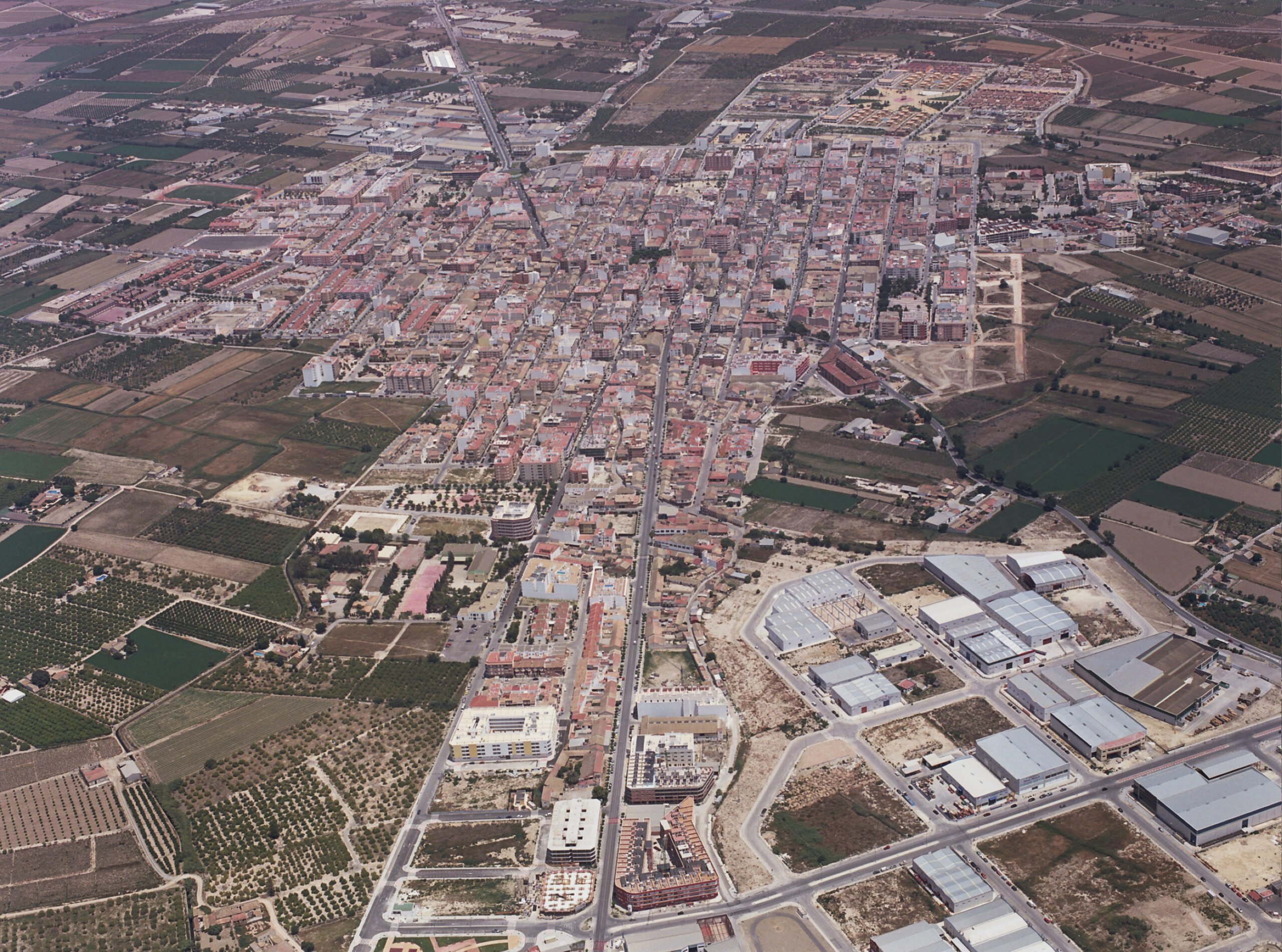
We close with what any sceptical reader would ask for: bringing the theory down to earth. We take a typical mid-sized town in the Vega Baja: around 20,000 inhabitants and some 9,000 homes (the scale of Callosa de Segura or Almoradí), a town centre of ground floor plus one or two storeys, an ageing housing stock, resale homes at €870 – 1,250/m², almost no new build (section 6) and demand growing through population and outside buyers in the entry-level segment. Note: what follows is a theoretical exercise with explicit assumptions and rounded figures, not a forecast. Every assumption is debatable, and that is precisely the point of putting it in writing.
The package, applied in year 0 (all within municipal or regional powers, nothing exotic):
- Building permits genuinely resolved on time (two months as the target), with declaración responsable (works notice) and checks afterwards wherever the law allows.
- A plot-pooling plan in the most run-down blocks: a buildable-area bonus up to ground floor plus three or four storeys, with setbacks, in exchange for pooling at least three plots and giving up open space at ground level.
- Swap with a municipal guarantee: every owner who contributes their house receives a new flat in the resulting building, with rehousing during the works.
- A renovate-or-replace test for every building that applies for subsidies: whatever passes the test is fully renovated; whatever does not goes into the plot-pooling plan.
- Municipal land under surface rights for 60 affordable rental homes through public-private partnership.
- Regulated change of use from empty commercial premises to housing, with full habitability.
Starting assumptions. There are around 25 plots available today (vacant sites and ruins) and another 8 that become free each year. The typical operation pools three plots (around 300 m² of land) and puts up a building of ground floor plus four storeys, with around 12 homes where there used to be 3 houses. And the key assumption, which should not be hidden: with the swap, the land is paid for with three flats instead of cash, but at inland prices (around €1,650/m² for new build) each operation leaves the gap we calculated in section 5, of roughly €85,000 to €315,000. It would be covered by the regional and national subsidies that currently go to superficial renovations: for some 40 operations over fifteen years, in the order of €8 million, a little over half a million a year. If new-build prices rise towards €2,000/m², the gap disappears.
| Timescale | What happens (on these assumptions) | New or renovated homes, cumulative |
|---|---|---|
| Years 0 – 3 | 60 public rental homes, the first 3 plot-pooling operations with swaps (around 36 homes, 9 of them for the former owners) and around 15 changes of use | ≈ 110 |
| Years 3 – 8 | Around 3 operations a year once they are shown to work, and around 5 changes of use a year; the first blocks visibly renewed | ≈ 310 |
| Years 8 – 15 | The mechanism becomes routine: 3 or 4 operations a year and around 3 changes of use a year; renewal of the town centre and public space gained with each operation | ≈ 600 – 650 (around 7% of the current stock) |
These are gross figures: each operation replaces three old houses, so the net gain is around 500 homes. And the numbers are consistent with the land available: over fifteen years, some eight or nine plots a year would be needed.
What we could expect from prices. We need to be cautious here: with demand across the area rising, this package would probably not bring prices down in absolute terms. The reasonable expectation is relative moderation (prices and rents rising less than in comparable towns that do nothing) and, above all, more decent homes in the entry-level segment, which is where supply is almost non-existent today. In return, the town gains revenue (construction tax, IBI on the new build), local employment for fifteen years and a town centre that renews itself instead of fossilising.
What it would not achieve, also in writing: it does not replace national housing or tax policy, and it does not work without commitment sustained over more than one term of office, which is probably the hardest assumption of all.
We invite any town hall or developer to discuss these assumptions with their own specific case on the table.
Sources: An exercise prepared by Unité Arquitectura based on the data and mechanisms in sections 4, 5, 6 and 10; planning and cost parameters are indicative · INE, 2021 Census: homes by municipality
Conclusion: a problem of process, not of bricks
If this article had to be summed up in one paragraph, it would be this. Spain does not build the homes it needs because the process fails in four places at once: land takes one or two decades to be ready, the renewal of what is already built is blocked by legal padlocks, in 2008 the sector lost many of the firms and hands that knew how to build, and across much of the interior the market pays less than it costs to build. On top of that jammed system falls growing demand: new households, outside buyers, new uses of the housing stock. The result is a shortfall of some 750,000 homes and the prices we all know.
The two most repeated explanations do not stand up to the data. It is not the investment funds: with more than 90% of rental housing in the hands of private individuals, their weight does not explain the problem as a whole, however real some cases may be. Nor is it enough to leave it to the market: without a public rental stock, without taxation that favours mobility and without a planning process that works, the market only builds where the numbers add up, which today is mainly the coast and the cities. The levers that work are less eye-catching: permits on time, land ready to build on, buildable area where there is demand, renewal instead of patching, a publicly guaranteed swap for the last neighbour, real renovation where the building deserves it, viable protected-housing prices, public rental housing under surface rights, industrialisation and skilled trades. None of them makes headlines; all of them fit in an official gazette or a town council meeting.
What this article does not cover in depth. Tourist lets and empty homes weigh on the debate, and in some neighbourhoods and much of the coast they really do weigh. They deserve their own analysis, with town-by-town data and both readings on the table, and we would rather leave them for another article than dismiss them in two lines.
Land in Spain is not a scarce resource: it is a slow one. And housing is not a problem of bricks, but of process.
Methodological note. This article has been prepared from public sources (Banco de España, INE, Ministry of Housing, Colegio de Registradores, Eurostat, OECD, Generalitat de Catalunya, Fedea, idealista and the academic literature cited), with data up to October 2026 and linked in each section. Our own estimates (replacement cost, the comparison of inland prices, the exercise in section 11) are marked as such and are debatable by design. The text is not aligned with any party: where the data has two readings, both are presented; where we give our opinion as professionals, we say so.
If you are a town hall, a developer or a private individual and want to bring any of these numbers down to your own case, let's talk: write to us from the contact page.
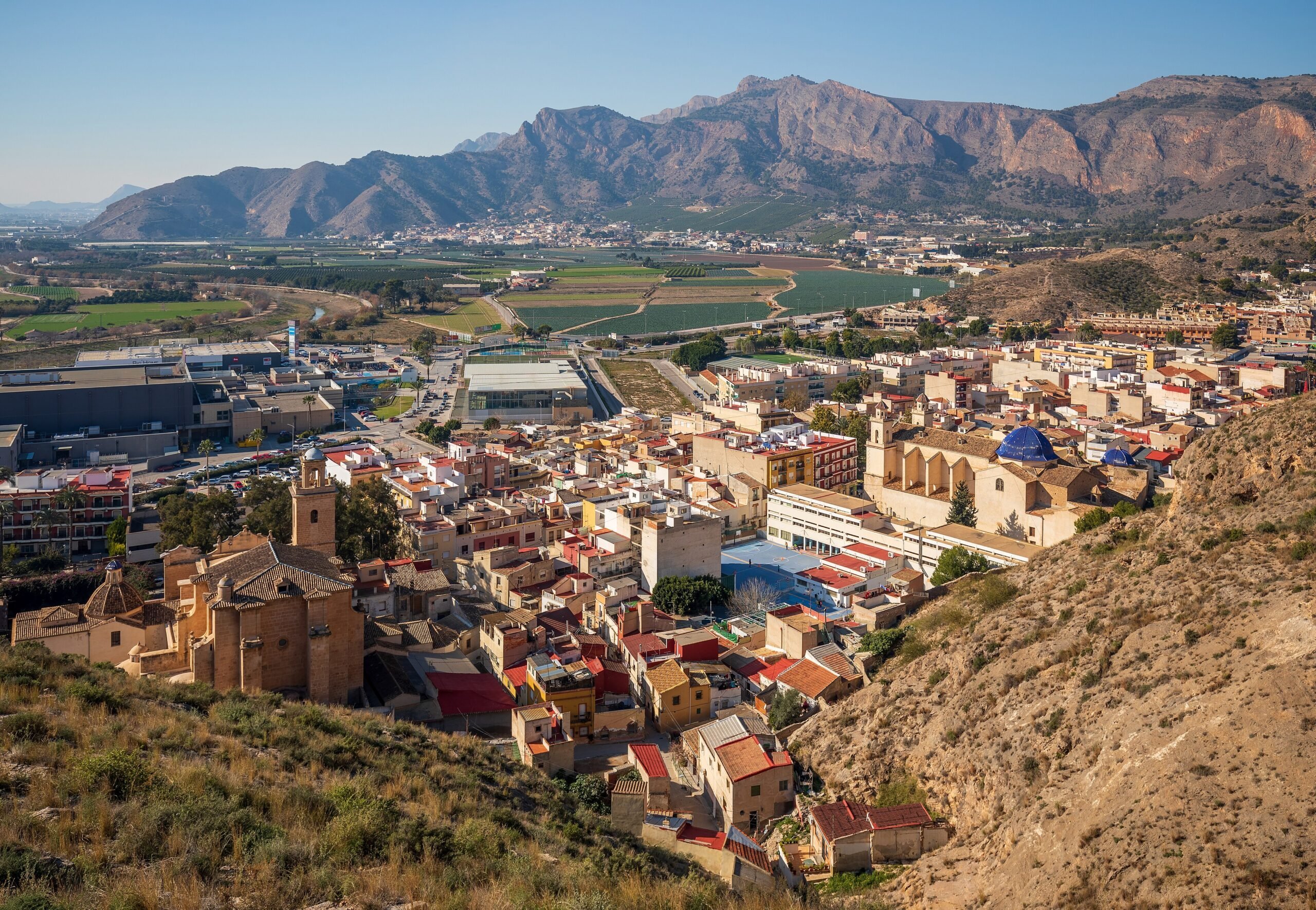
Cover photo: Orihuela, its huerta and the sierra, seen from the San Miguel seminary. Photo: Ximonic (Simo Räsänen) · CC BY-SA 4.0, via Wikimedia Commons.