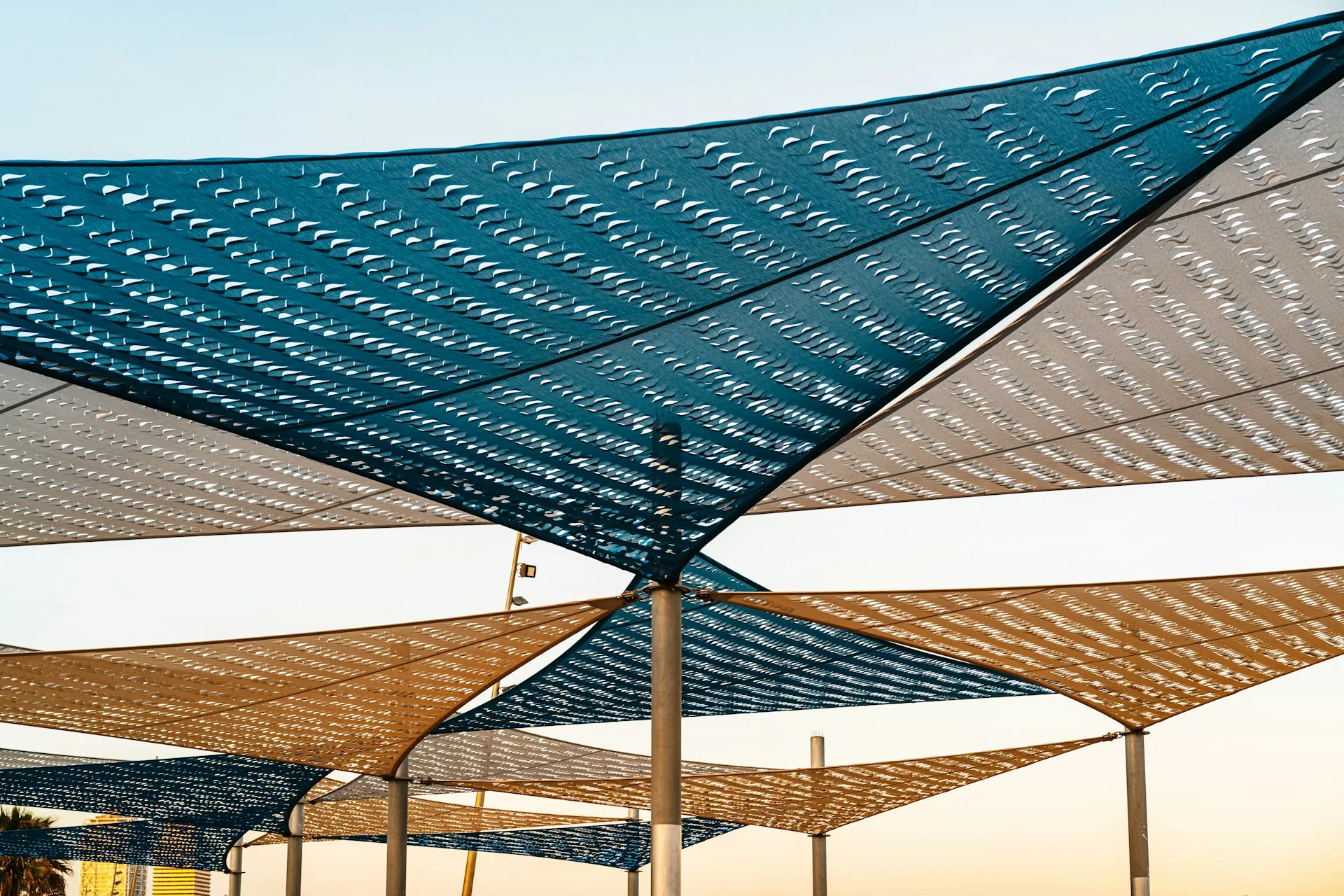
Shade sails in schools: why a piece of fabric needs engineering, posts and footings
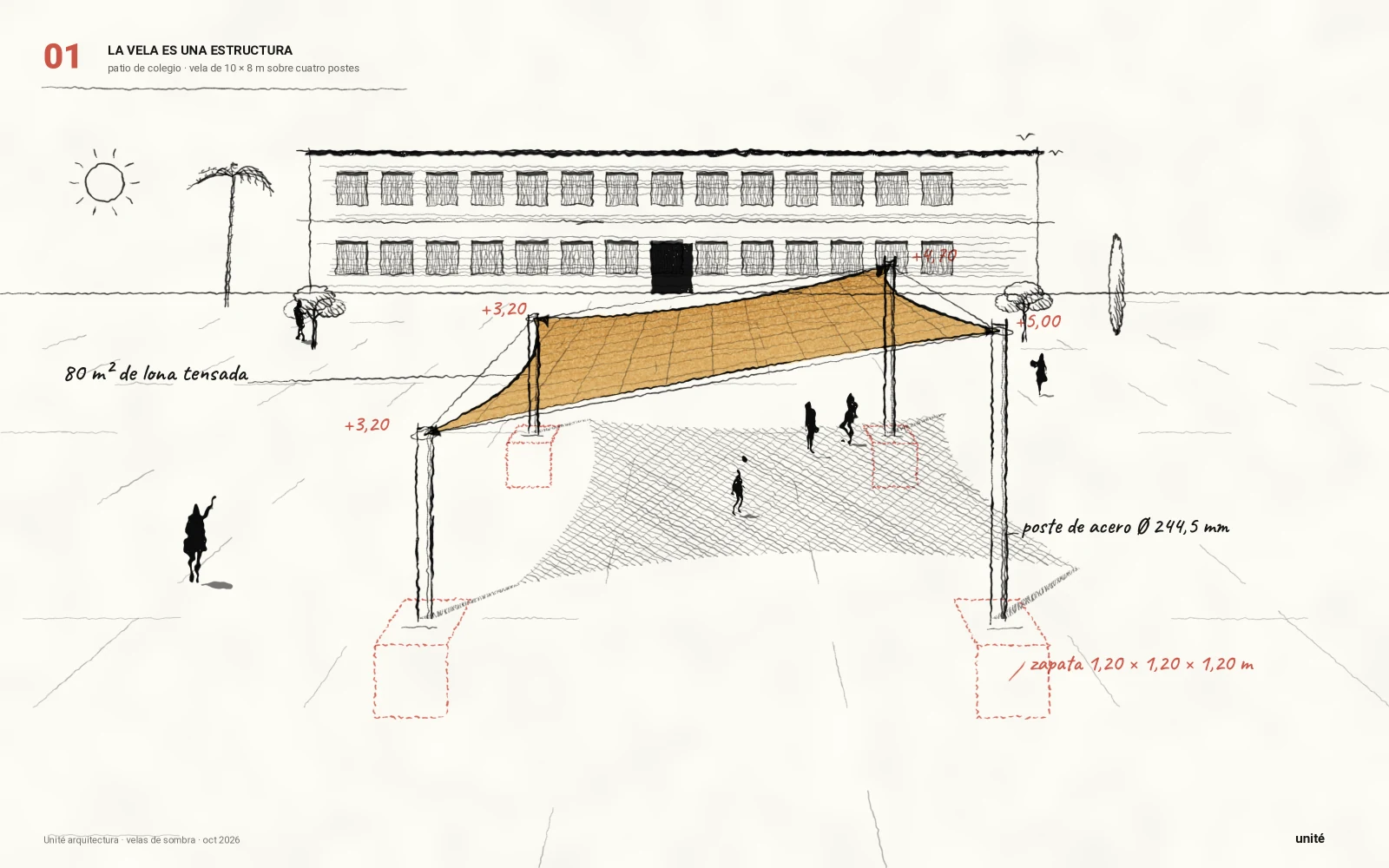
With summers getting longer, many schools want shade in the playground. The quickest solution is a tensioned shade sail: a piece of fabric stretched between four posts that can be put up in a couple of days. It looks like a big awning, but it is a structure, and as such it has to be engineered.
This autumn we have done the structural calculations for several of them, in school playgrounds in l’Alacantí, the Marina Alta and the Vega Baja: the calculation model, the posts, the footings, the anchors and the technical report the regional Education Department (Conselleria) asks for before it authorises the installation. This is what lies behind that shade.
A 21-kilo fabric that holds 4,600
A 10 × 8 m sail has about 61 m² of fabric. The fabric weighs 340 grams per square metre: the whole sail, about 21 kg. With that weight it is hard to imagine anything could go wrong.
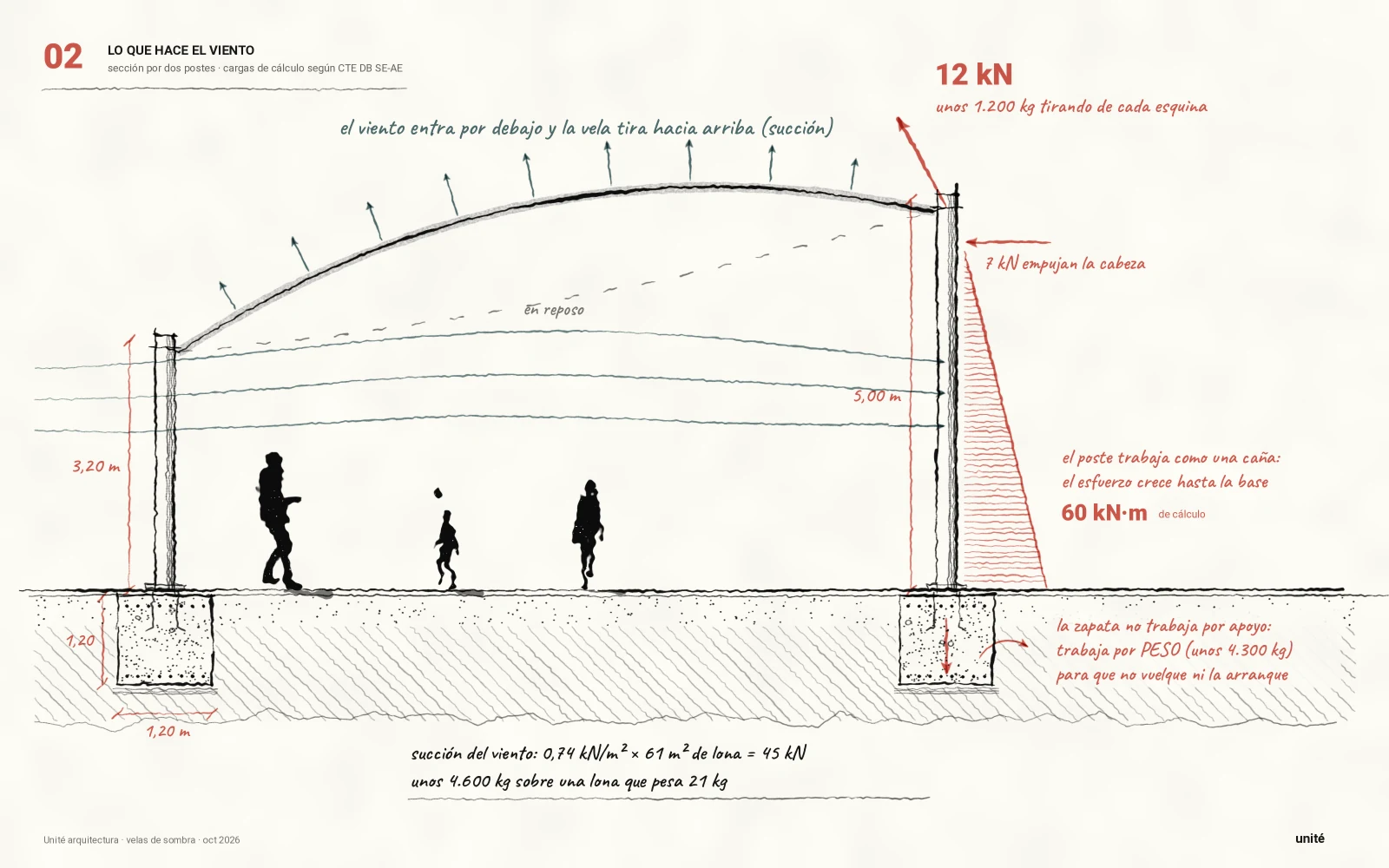
The problem is the wind. When it blows, it gets under the sail and pulls it upwards, as if it were an aeroplane wing. The Spanish Building Code (CTE DB SE-AE) sets the pressure to be used depending on the area, the height and the surroundings. In a school in l’Alacantí, for example, the design uplift comes out at 0.74 kN/m². Multiplied by the fabric, that is about 4,600 kg pulling on it, which ends up shared between the four corners.
And it is not a simple split. A fabric has no stiffness: it only works in tension and deforms with the wind until it finds a new balance. That is why dividing by four is not enough. We obtain the forces at each corner from an analysis of the deformed membrane, the method set out in the European specification for tensioned membrane structures (CEN/TS 19102), and then we put them into the model of the posts with their real size and direction.
A flat sail pulls harder
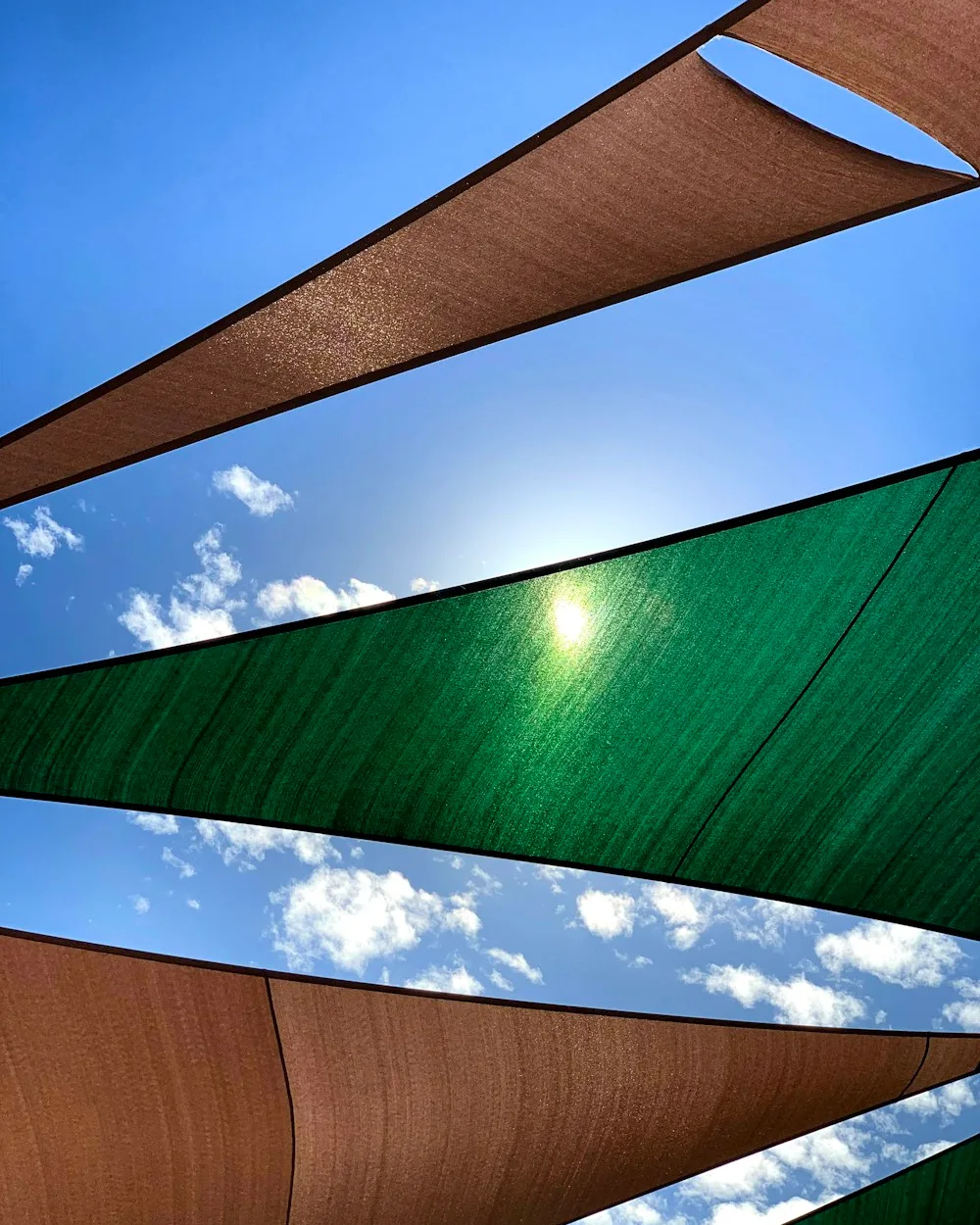
A strongly twisted sail, with its corners at very different heights, spreads the load better. An almost flat one pulls harder on its corners. That is why the posts are set at different heights: besides shedding the rainwater, the shape makes the fabric work better.
The post works like a fishing rod
Each post is a cantilever: fixed at the bottom and free at the top. The sail pulls on its head and all that effort travels down to the base, where it builds up. On a 5 m post, the corner of the sail pulls with about 12 kN (like hanging 1,200 kg from it), of which about 7 kN push the head sideways. At the base, that becomes a design bending moment of about 60 kN·m.
Those figures are what the tube is chosen from. Installers' sketches sometimes come with 165 mm posts. For a sail with a 5 m post, this is what the calculation says:
- 219.1 × 6 mm tube: does not pass (it would work at 115% of its capacity).
- 244.5 × 5 mm tube: does not pass (109 %).
- 244.5 × 6 mm tube: passes (92% on the tallest post).
We use the same tube for all four posts, the one the most loaded post needs: it is easier to fabricate, to install and to explain, and the playground looks tidy. And we always look for the smallest diameter that works with a reasonable wall thickness, because a slimmer post gets in the way less in a playground.
The footing works by weight
This is the part that surprises people most. The ground of a playground easily takes what a sail transmits to it: in the l’Alacantí case, the maximum pressure under the footing was 0.13 MPa, far below what the soil can bear. What governs is not the footing sinking, but making sure that the wind neither overturns it nor pulls it out.
And that can only be achieved with weight. A 1 × 1 × 1 m footing did not reach equilibrium against overturning. The solution was a 1.20 × 1.20 × 1.20 m one: 1.73 m³ of reinforced concrete, about 4,300 kg per post. We prefer footings that are deeper than they are wide: they weigh the same, take up less of the playground and need less of the paving to be broken up.
For such a light installation, the Spanish code allows the ground to be justified without a full geotechnical survey, using the official geological map (the IGME MAGNA map) and one condition: inspecting the bottom of every excavation before pouring the concrete. If fill, soft soil or water appears, the footing goes deeper or a survey is carried out. That step is not a formality: it is where you check that what was calculated is true.
The head: a ring, a shackle and a turnbuckle
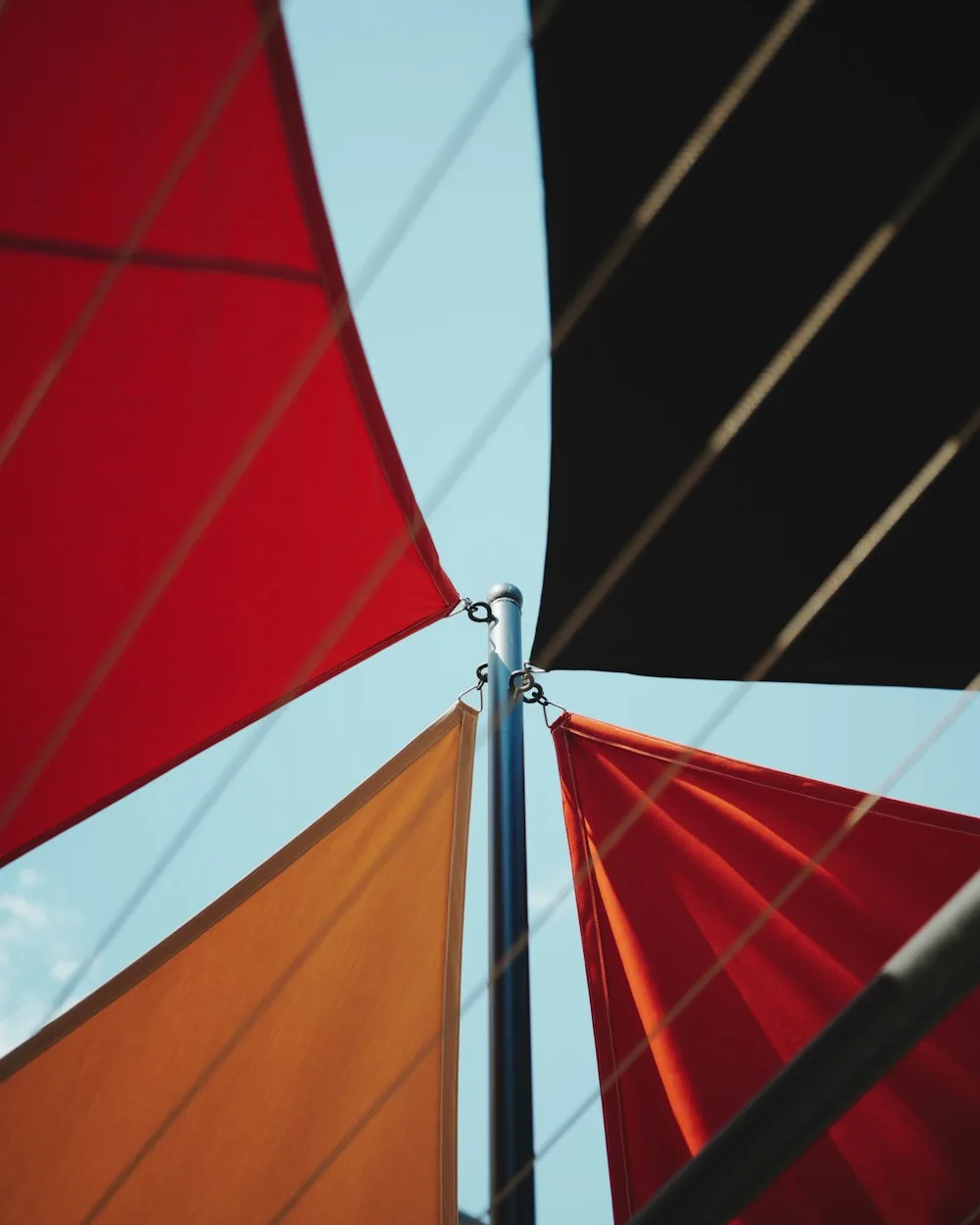
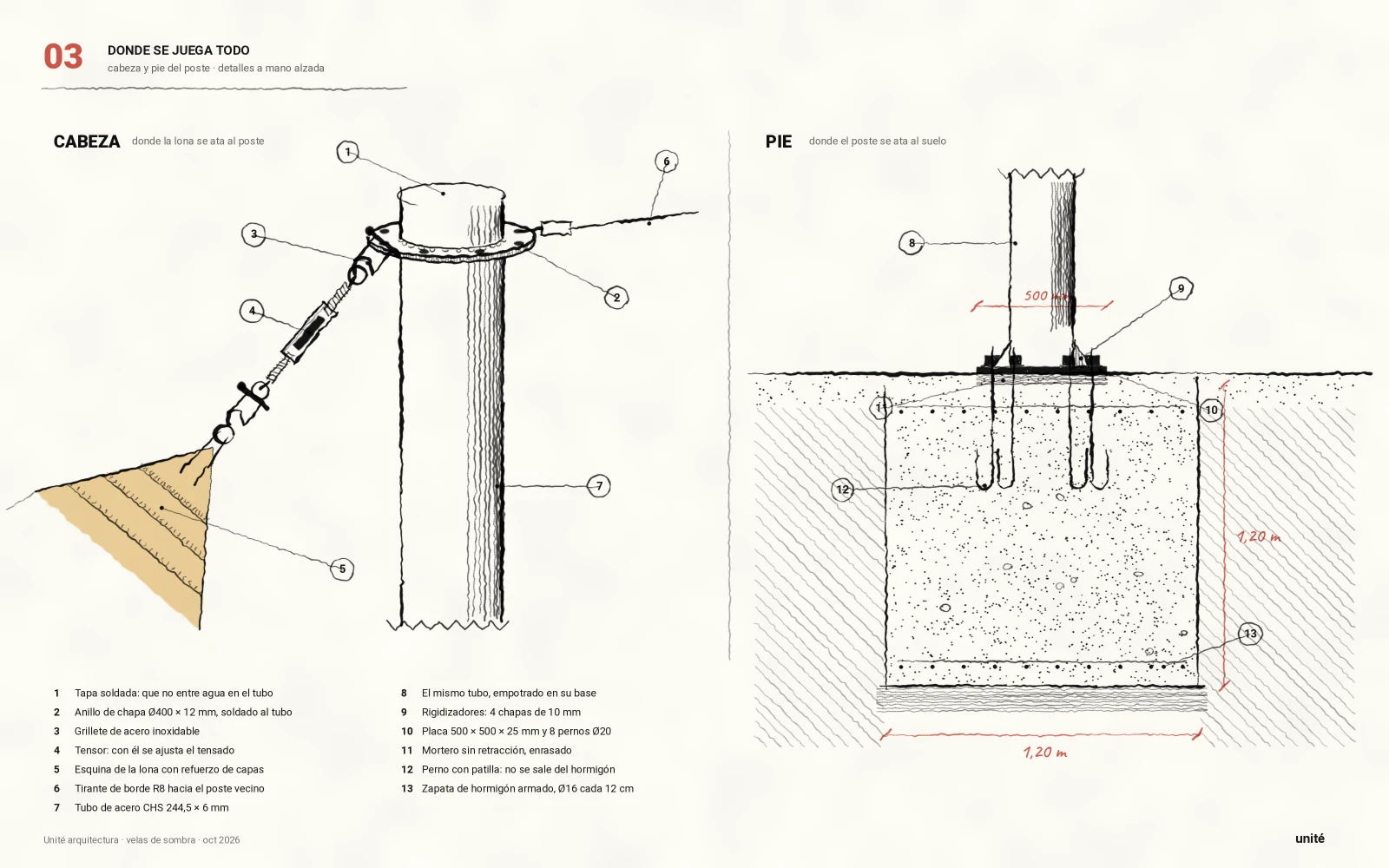
The sail is not tied to the post just any old way. A 12 mm steel ring plate with holes is welded to the head; from it hangs a shackle, a turnbuckle and another shackle that takes the corner of the fabric. All in A4 stainless steel, with a working load of at least 1.5 tonnes. The turnbuckle is used to give the fabric just the right tension and to re-tension it over time.
The corner of the fabric has several stitched reinforcement layers, because that is where the load concentrates. And the fabric is not equally strong in both directions: one way it holds more than three times as much as the other. That is why we specify how to orient the fabric, with its strong direction along the diagonal that pulls hardest.
At the foot, the post is welded to a 500 × 500 × 25 mm base plate with four stiffeners and eight 20 mm hooked anchor bolts cast into the footing. The plate is flush with the paving, with no visible bolts or bumps.
If the sail is anchored to the façade
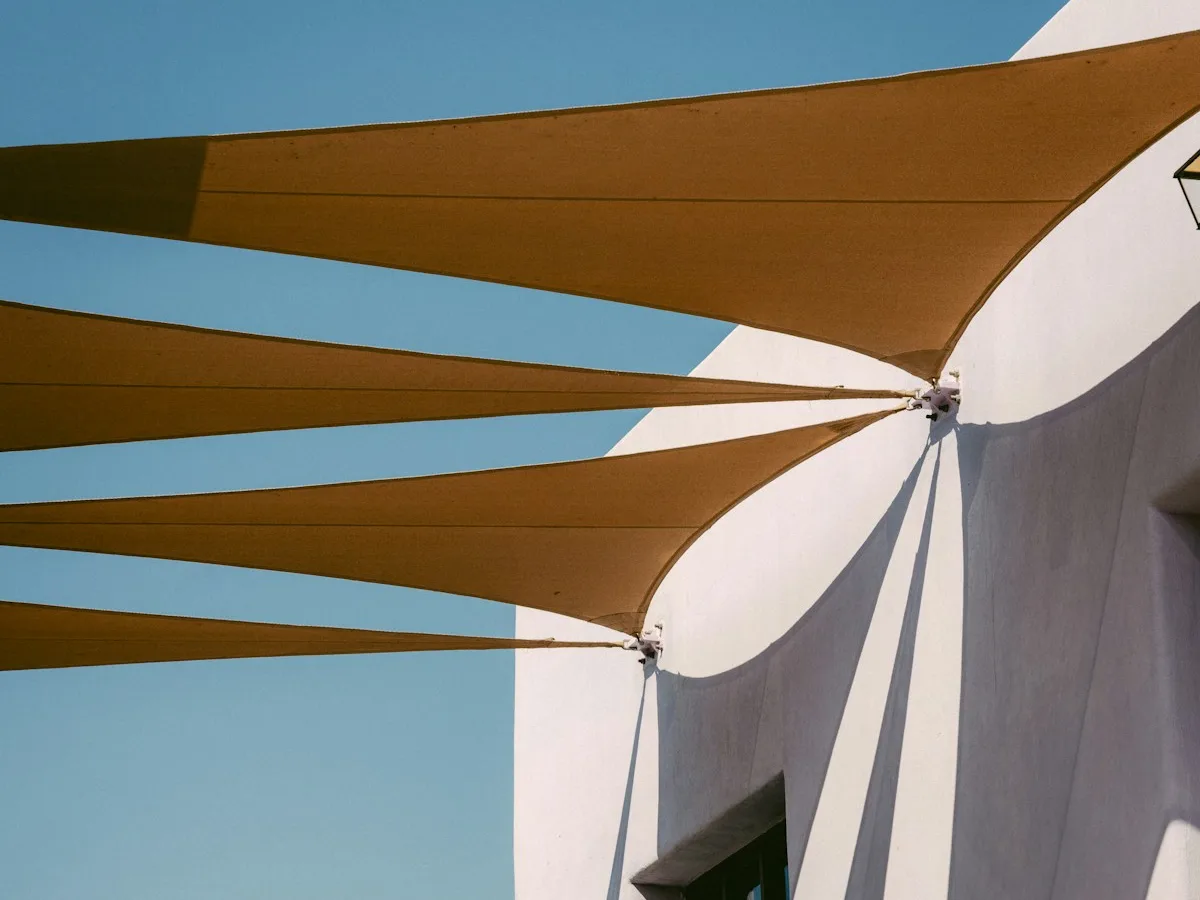
Sometimes a corner goes not to a post but to the wall of the building. It is convenient, but that wall then takes the pull of the sail, and not every wall can. In a secondary school in the Vega Baja with anchors on the façade at 3.50 m, the calculation includes the pull reaching each anchor, and on site the wall and the chemical anchor have to be checked. A parapet, a hollow block wall or a cladding is not an anchor point.
What the Conselleria asks for
To authorise a sail in a state school, the Conselleria asks for a technical file. This is the list and who provides each item:
- Photographs of the location. Provided by the school.
- CE marking of the fabric or the awning (UNE-EN 13561). Provided by the manufacturer.
- Fire reaction certificate for the fabric. Provided by the manufacturer.
- Technical data sheet with the sun protection. From the manufacturer, included in the report.
- Technical report signed by a qualified professional, with the materials, the anchors, the foundations and the ultimate and serviceability limit state calculations.
- Dimensioned drawings with layout, setting out, foundations, base plates, anchors and welds.
Watch out for the fire certificate
Many quality shade cloths come with American or Australian tests (NFPA 701, AS 1530) that are not directly equivalent to the Spanish classification. What has to be provided is the fire reaction class under UNE-EN 13501-1 (C-s3,d0 or better, equivalent to the old M2) or an M2 certificate. It is worth asking for it before buying the fabric.
Safety in a playground full of children
The Building Code also has something to say about use (CTE DB SUA). In a playground, this is how we deal with it:
- Round posts, with no sharp edges or protrusions, in a colour that contrasts with the ground and away from the main walkways.
- The lowest point of the sail, including the curve of its edges, no less than 2.20 m above the ground.
- Shackles, turnbuckles and tie rods above 3 m, out of the pupils' reach.
- Base plates flush with the paving and no visible bolts.
- Installation with an aerial work platform and, if possible, outside school hours.
Maintenance: what nobody tells you
A sail is neither forever nor something you can forget about. This is what we write down in the report:
- After a storm: check the fabric, seams, fittings and turnbuckles, and re-tension it if there are pockets or wrinkles.
- Once a year: tighten the nuts, check the shackles and pins and the condition of the paint or galvanising.
- With an orange or red wind warning: take the fabric down, it is removable.
- In the months without strong sun: it can be taken down, and it lasts longer.
- Every five years: a professional inspects the structure and the foundations.
And one rule for the playground: nothing is hung from the sail or the tie rods, and nobody climbs the posts.
How we work with installers
- You send us a sketch. Plan dimensions, the height of each corner and where you can dig. Hand-drawn and photographed is fine.
- We calculate. The real loads of the fabric and the model of the posts and footings in CYPE 3D, looking for the slimmest post and the smallest footing that work.
- We hand over the documents. The technical report with everything the Conselleria asks for and seven drawings: layout, setting out, foundations and base plate, 3D view, loads, welds and sail anchorage.
- You install. The installer builds it and issues the installation certificate. If the school needs it, we also sign the report and supervise the works.
Frequently asked questions
Does a sail need a permit?
In a state school, the Conselleria authorisation with the technical documents above. In addition, depending on the town hall, a declaration of works (declaración responsable) or a minor works permit may be required, because there are foundations. It is worth asking before you start.
And at a house or a restaurant?
The reasoning is the same: the wind makes no distinction. At a home you do not have to go through the Conselleria, but the posts and footings have to be calculated just the same, and if it is anchored to the façade the wall has to be checked. A badly anchored sail is a risk for whoever is underneath and for the neighbour.
Why is it not enough to set the post in concrete in a hole?
Because what has to be resisted is overturning and uplift, and that depends on the weight and shape of the footing and on how the post is connected to it. A block of concrete poured «by eye» can last for years and fail on the first day of strong wind.
Which fabric should I choose?
A micro-perforated high-density polyethylene (HDPE) fabric, with a Spanish fire reaction classification, blocking between 90 and 96% of ultraviolet radiation. Because it lets some air through, the wind affects it a little less and in summer it gives cooler shade.
Are you an installer or a school?
Send us the sketch with the dimensions and heights and we will tell you which posts and footings you need, and what documents you need for the Conselleria.
You will find more information on our page for professionals. You can write to us from the contact page or on WhatsApp at +34 633 39 85 44.
Cover photo: Eduard Pretsi on Unsplash. The drawings are by Unité arquitectura, based on real calculations from this autumn; the figures correspond to a 10 × 8 m sail at a school in l’Alacantí.
Further reading
- Spanish Building Code (CTE): DB SE-AE (actions; wind in annex D), DB SE-A (steel), DB SE-C (foundations) and DB SUA (safety in use).
- Structural Code (Royal Decree 470/2021): reinforced concrete and structural steel.
- UNE-EN 13561: external blinds and awnings, performance and CE marking.
- UNE-EN 13501-1: fire reaction classification of construction products.
- CEN/TS 19102: design of tensioned membrane structures.